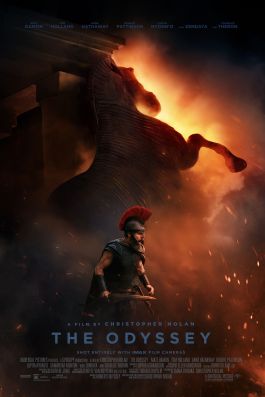
This is a hard film to love the first time and an easy one to respect the second. Christopher Nolan's The Odyssey asks more of you than anything he's made since Interstellar. The first two-thirds is a gorgeous slog, and only in the final third does it click and show you the slog had a job to do. Or maybe half of it is a slog and the second half is not but that first half felt like a lifetime. It's one of the few films I'd score twice: a 3.5 the first time through, a 4 on the rewatch. I'll get to why. First, a warning, because this movie is rough on anyone who wanders in cold.
Do your homework first
If you've never read the poem, a lot of this washes over you. The names are old and unfamiliar, the cast is enormous, and the time jumps don't sort themselves out until you're well into it. You can follow the film with no prep, but you'll get far more from it if you skim a summary of Homer before you go.
And this isn't a movie you can duck out of for a refill. Leave for popcorn and you'll lose a thread you needed.
Know who you're looking at
Odysseus (Matt Damon) is the king of Ithaca trying to get home from the Trojan War, and the film is almost entirely his. Back in Ithaca, his wife Penelope (Anne Hathaway) is holding the kingdom together and fending off suitors who keep insisting her husband is dead. The worst of them is Antinous (Robert Pattinson). Their son Telemachus (Tom Holland) is growing up in his father's shadow.
Out at sea, Odysseus runs into the goddess Athena (Zendaya), the sorceress Circe (Samantha Morton), the nymph Calypso (Charlize Theron), and a long parade of other gods and monsters. Hold onto that list. The movie never slows down to reintroduce anyone.
The point under all the monsters
The film is a chain of set-piece trials, and I'll keep the monster-by-monster stuff behind the spoiler wall. What's worth saying up here is the idea running underneath, which is sharper than "man takes long trip home."
The backbone is xenia, the old law of hospitality: welcome the stranger, feed the beggar, because the wanderer at your door might be a god in disguise. It sounds quaint until you watch how easily people break it. The greedy and the clever keep taking something meant to be sacred and turning it into an angle. That's the real subject. Not the gods and monsters, but the way people corrupt what's holy, walk into places that aren't theirs, and convince themselves they were owed it. Watch it in 2026 and it stops feeling three thousand years old.
The trials each take something from him. His men, his loot, his certainty. And each one asks a question the film clearly means. How long does it take for hard times to wear down your morals? When is "just hold out and wait" something only comfortable people get to say? What does a leader owe the few when the many are on the line? Odysseus answers that last one coldly, spending a few lives to save the rest, and the film makes you sit with what it costs him.
Damon holds it up, and Nolan gets mean
Damon is the whole foundation. Nolan hands him room to take Odysseus from cocky warlord to hollowed-out survivor, and he earns it. The bigger surprise is Hathaway, in a small part that pays off enormously at the end. For most of the film Penelope just waits, boxed in by circling suitors, and then the last stretch arrives and you feel every year she's been carrying. Pattinson, meanwhile, is having a great time as a coward who gets other people to do his killing and never faces anyone himself.
The craft is huge, which you'd expect, and it has a mean streak I wasn't ready for. Nolan shot this in full IMAX and the practical creature work is scarier than it has any right to be. The Cyclops scene plays like a horror movie, and I mean that as a compliment. What he hasn't fixed is the pace. The first two-thirds drags, no way around it. It rewards patience and a second watch, but the first time through it wears on you, and a few beats land flat because the gods already told you they were coming.
A content heads-up: this is a hard R. Nolan doesn't clean up the ancient world for you. The violence is brutal, and the film plays the cruelty of the era as horror rather than adventure. Worth knowing before you bring anyone who isn't up for it.
So it's a GLOWING 3.5 that turns into a 4 the second you rewatch it knowing where it lands. It's too long, too crowded, and a little too in love with its own slow build. It's also the most thought-provoking blockbuster of the year, and the ending pays back everything that tested your patience to get there. Do the reading, clear your evening, and let it work on you. Maybe just not on a night you're already tired.
A note before the deep water. The film is a chain of trials, and every one is a chapter in Odysseus (Matt Damon) losing something. Here's what the big ones mean, because a lot of them look like monster-of-the-week and are quietly doing something else.
Troy, and the first broken law. The Trojan Horse is presented as a gift "for the gods," which is the first time something sacred gets turned into a weapon. When the Greeks sack the city, they kill the priestesses of Athena (Zendaya) inside her own temple, with Odysseus wearing her sigil while it happens. Everything that goes wrong afterward flows from that. You break the god's law, the god collects.
The Cyclops (Bill Irwin) and Poseidon's grudge. Odysseus's men walk into Polyphemus's cave uninvited, help themselves, and provoke him, then act shocked when he defends his home by eating two of them. If they'd just left, none of it happens. Instead Odysseus blinds him and taunts him, the Cyclops prays to his father Poseidon, and the curse that dooms the whole voyage is set loose. It's the hospitality law flipped on its head. The same men who expect a warm welcome everywhere won't give one anywhere.
Circe (Samantha Morton) and the pigs. The transformation is shown in slow, graphic detail. It isn't a puff of magic, it's a horrible literal shrinking of men into swine, and that's deliberate. The pig is the animal of appetite. Take the reason out of a man who's ruled by his stomach and his lust, and that's what's left. But Circe isn't the villain the men assume. Once Odysseus finds her weakness and stops her, she becomes his guide and hands him the prophecy and the way home. Circe is unfairly cast as the villain by the men. Once Odysseus stops her, she becomes the person telling them the hard truth about what lies ahead.”
Hades, and a symbolic death. The blood sacrifice that opens the underworld plays like a horror set-piece, and it works as a death and rebirth. Odysseus goes down to talk to the blind prophet Tiresias (James Remar), comes face to face with his own mortality, and returns knowing his crew is doomed and he'll be the only one left to reach exile. He tries to dodge it. He can't.
The Sirens, and the point of the mast. This is the smartest beat in the film, so it's worth spelling out. The crew plug their ears, because they can't be trusted near the temptation and so they're kept away from it completely. Odysseus alone chooses to hear the song, but he has himself tied to the mast so he can't act on it. That's the whole lesson about self-control. It isn't about pretending temptation doesn't exist. It's about setting up the restraint ahead of time so you can face the thing and survive it. He feels the full pull and lives because he tied himself down first.
Scylla and Charybdis, the leader's math. The whirlpool-and-monster stretch can't be beaten. You physically cannot avoid both. This is where the film's running "lose a few to save the rest" logic gets said out loud, and it's brutal. Odysseus knowingly lets the monster take six men rather than lose everyone, and he carries it. Leadership as a run of impossible subtractions.
Helios's cattle, and morals under starvation. The sharpest stretch in the movie. Stranded by a dead wind, warned that touching the sun god's cattle means death, the starving crew hold out, and hold out, and finally break. The film sits right in the tension: how long before hunger wears down your values, and how much of "just endure and wait" is easy to say when you're not the one starving. Then Zeus does what Zeus does, and a lightning bolt shatters the ship and drowns everyone but Odysseus.
Calypso (Charlize Theron), the comfort trap. Washed up alone, Odysseus lands on Calypso's island, where she heals him and keeps him there. She isn't a monster, and she isn't really a companion. She's the temptation to stop. Take the comfort, take the immortality the myth offers, and give up the hard road home. Odysseus turning that down is the entire point of her. Nothing outweighs getting back to Ithaca, not even never dying.
The stripping-down. Look at the shape of it. Ships, loot, crew, all of it peeled away one trial at a time until only Odysseus is left. The journey isn't set dressing on the way to a reunion. The losing is the story, right up until there's nothing left but the man and his need to get home.
The return, as a beggar. This is where the film finally speeds up and it all clicks. Odysseus comes home disguised as a beggar instead of marching in for a hero's welcome. That pays off the whole hospitality theme, and it's the hardest thing he's learned. Show up in triumph and you'll find the knives out. So he watches, he listens, he works out who kept faith and who didn't, he protects his son Telemachus (Tom Holland), and only then does he strike. Argos, his old dog, waited years for him, knows him through the disguise, and dies the second he comes back, like he was holding on for one last look. It's the saddest thirty seconds in the film. And the reunion with Penelope (Anne Hathaway), the Athena pin, the recognition, is what makes the slow first half ache in hindsight. You finally feel all the years she sat there, surrounded, mourning a man everyone swore was dead.
And the last note, "toward the west." The prophecy that he has to set out again, heading west, is Homer's unfinished ending. The wandering doesn't fully stop. Odysseus and Penelope get their reunion, but the film leaves the horizon open. The man who spent ten years desperate to get home may never really get to stay there.
The whole point. Take the gods out and it's a film about people being people. Greedy, cunning, willing to kill one man over a woman or a crown or a little power, wrecking whatever's sacred and walking into whatever isn't theirs. The hospitality law cuts both ways. The suitors violate Odysseus's home the same way his men violated Circe's and the Cyclops's, and the arrogance always comes back around. That's the bleak, timeless thing sitting under all the spectacle. Give people the chance, and they tend to act like the pigs.
Bright Bulbs
- Matt Damon's Odysseus. He takes the character from cocky warlord to hollowed-out survivor, and the film gives him room to earn all of it.
- Anne Hathaway's Penelope. A small role that pays off bigger than anything else in the movie. Years of quiet grief that hit hard at the end.
- The practical horror. Nolan shoots the monsters like a horror director. The Cyclops (Bill Irwin) scene plays like real horror, and the IMAX scale is overwhelming.
Shattered Bulbs
- The pacing. The first two-thirds drags hard, and "it pays off later" doesn't fully save a first watch where you keep checking the runtime.
- A steep barrier to entry. Too many characters, unfamiliar names, and time jumps that only sort themselves out once you're deep in. Come cold and a lot of it slips past you.
Cast
- Matt Damon as Odysseus
- Anne Hathaway as Penelope
- Tom Holland as Telemachus
- Robert Pattinson as Antinous
- Zendaya as Athena
- Samantha Morton as Circe
- Charlize Theron as Calypso
- Lupita Nyong'o as Helen of Troy / Clytemnestra
- Elliot Page as Sinon
- Himesh Patel as Eurylochus
- John Leguizamo as Eumaeus
- Jon Bernthal as Menelaus
- Benny Safdie as Agamemnon
- Bill Irwin as Polyphemus
- James Remar as Tiresias