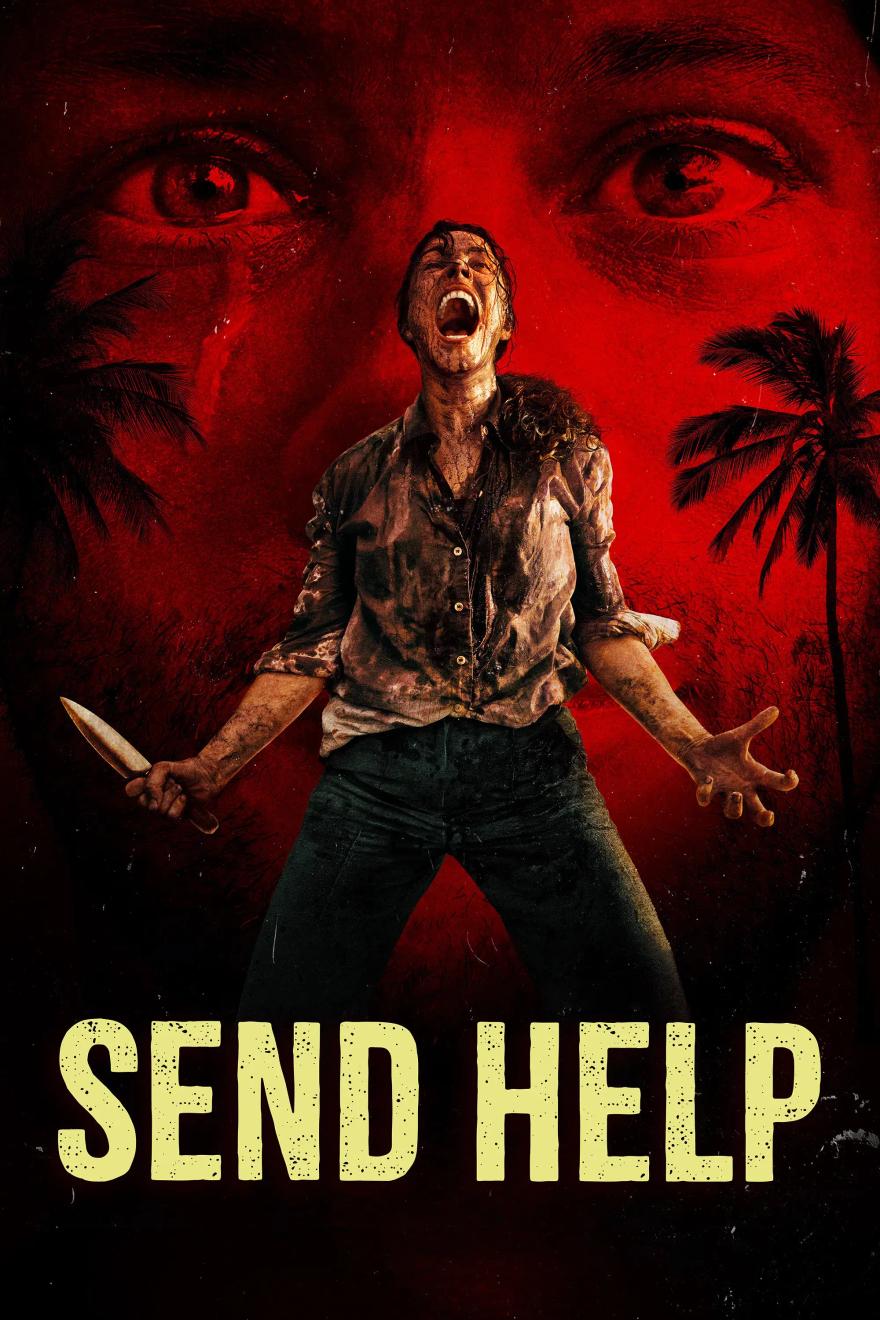
Before you press play
Watch if
You want to see Rachel McAdams play someone with no idea how she lands, and you can take Sam Raimi in full splatter mode.
Wait if
You need the workplace satire to stay a satire — or you're eating.
Send Help is a very funny film about work, bolted onto a survival comedy that eventually eats it. For about an hour it is the sharpest thing anyone has made about being the most competent person in a building where nobody wants to sit with you — quick, cruel, filthier than it needs to be, and built by someone who knows the island is the easy part. It then works out that it can escalate instead of argue, and spends most of the back half doing exactly that. Three bulbs.
What Send Help is about
Linda Liddle has spent seven years in strategy and planning being the best analyst in her building and the last person anyone wants at their table. Her evenings are a Survivor rerun and a pet bird called Sweetie.
Bradley Preston inherits the company from his late father and gives the vice-presidency to Donovan, a fraternity friend who has been quietly putting his own name on Linda's analysis. The reason Bradley offers is that Linda doesn't play golf. Franklin, a senior executive, is decent to her. Chase is not.
Then Bradley brings her onto the Bangkok trip to close a merger, and the plane comes apart over the Gulf of Thailand.
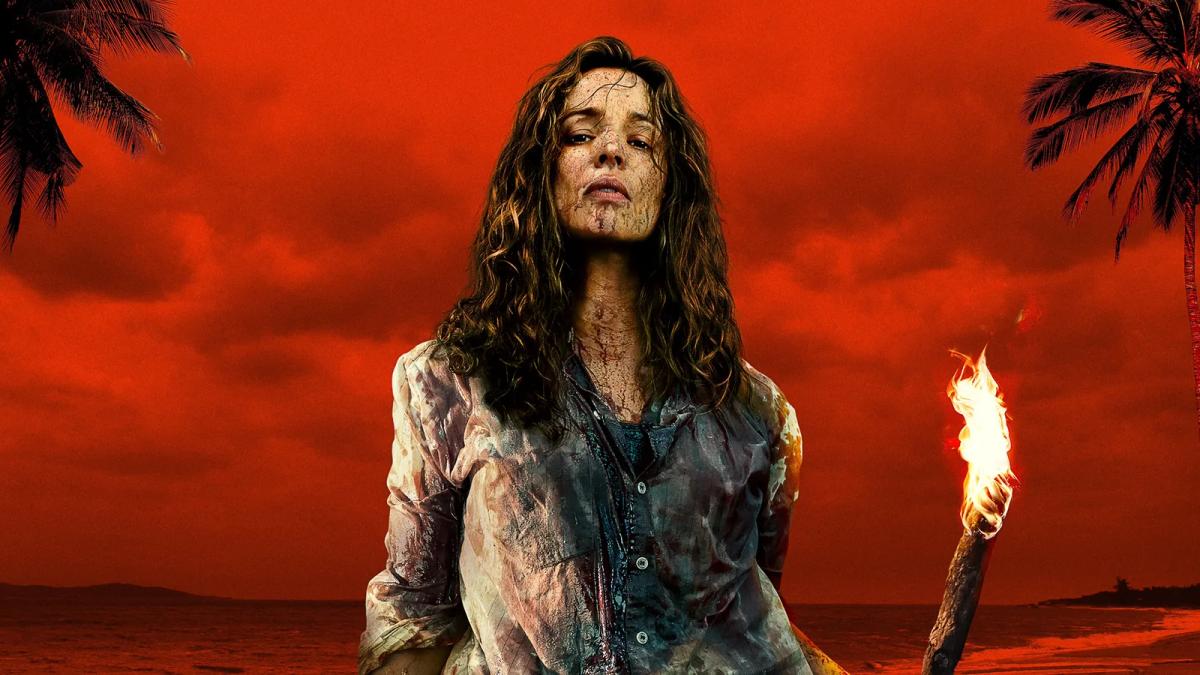
Rachel McAdams as Linda Liddle
She is the reason to watch. The lipstick is on Linda's teeth, the lunch smells, and she introduces herself to her new boss with tuna on her face and no idea it is there.
What keeps this from curdling into cruelty is the choice underneath it: Linda is not written or played as someone doing a bit, but as someone with no access to how she reads, who has never once been told. That is a whole tragedy delivered in a gesture.
Bradley could easily have been a cartoon and mostly isn't. Dylan O'Brien plays him as a man who has never in his life had to verify anything, which turns out to be funnier and considerably sadder than playing him as a villain.
What Send Help gets right about office politics
More than the premise required. Donovan takes the credit, Chase treats her as an ambient irritation, and Bradley's calculation is nakedly transactional — let her close the merger, then move her sideways.
But Franklin is kind to her, and it changes nothing. A workplace doesn't have to be uniformly cruel to keep somebody in it for seven years. It only has to be reliably indifferent, with one decent person in it to make leaving feel like an overreaction.
There is a second joke underneath the first. Donovan humiliates Linda on the plane by playing her old Survivor audition tape to the cabin. The thing they mock her for is the only reason anyone survives the week.
How gory is Send Help?
Gory, and wetter than it is frightening. This is a horror-comedy that lands far more laughs than scares, but it is Sam Raimi in the older register — fluids arrive at volume, stay on screen well past decency, and the film is delighted with itself about it.
If someone tells you not to eat during this one, they are not being cute. Treat it as a matter of taste rather than a fault: the audience this was built for will have an excellent time.
Where Send Help stops working
Once the power has flipped, the film stops developing its idea and starts staging incidents. Each is bigger and wetter than the last, and each says roughly what the one before it said.
The escalation is entertaining — Sam Raimi is very good at this — but it isn't an argument, and the first hour was making one. By the final stretch the film is louder than it is smart, and the difference is noticeable.
Is Send Help worth watching?
Yes, with the warning attached. Go for Rachel McAdams, who is doing something she has never done and doing it without a net. Stay for a middle stretch as precise about work as anything you will see this year. Expect a final act that gets louder rather than better.
If you want the same question about workplace power without the island, the Devil Wears Prada 2 review takes it up from the boss's side of the desk.
The boat Linda doesn't signal
Linda spots a boat while collecting fruit and lets it go by. She also finds a stocked house on the far side of the island the same day, and says nothing about either.
Everything after this is deliberate. She doesn't spiral — she manages. She withholds information, controls the exit, warns Bradley off the one part of the island that would free him and calls the warning concern, and lets him believe there is a future in staying.
What Linda does after the raft
Bradley poisons her dinner with berries, launches a raft he built in secret, and the surf breaks it up. She drags him back and is violently ill over him in the process.
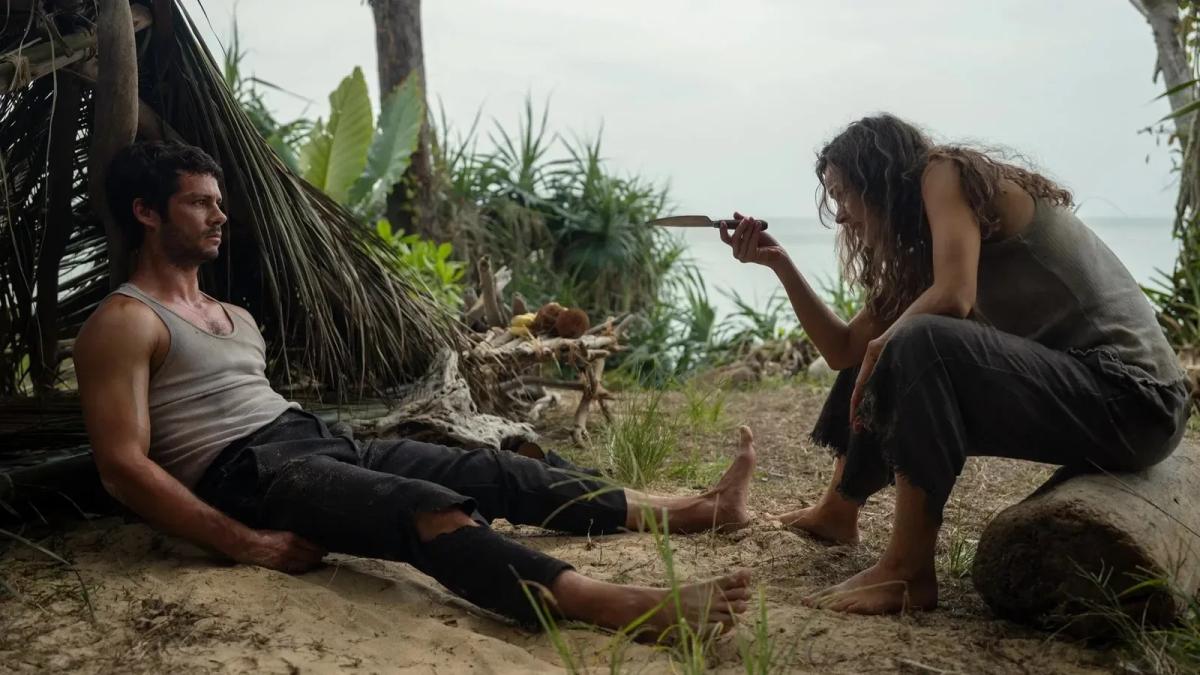
Then she paralyses him with octopus toxin, removes his trousers, produces a knife and mimes a castration. Dylan O'Brien plays it entirely through the eyes. Linda didn't become a monster out there. She got promoted, and she is running the department exactly as it was run on her.
Linda's husband
Over homemade fruit wine she tells him about her husband — abusive, not a good man, and one night worse than usual even by his own standards. She used to hide the car keys when he drank. That night she handed them over, poured him another, and let him drive away to die. Bradley answers with his own childhood: an abusive mother, a father rarely there.
In the moment it is the warmest scene in the film. Afterwards it is a résumé.
The questions it refuses to close are the best thing here. Did the husband die that way? Was it arranged? Was there a husband? Nothing later confirms a word of it. Bradley's story argues that people are made rather than born; the story Linda told sixty seconds earlier suggests she was finished long before this office got hold of her. The film declines to say which.
Zuri and the boat captain
Zuri arrives by boat after the official search has been called off. Linda kills her and the boat captain, and buries Zuri in the sand.
This is where the film stops letting Linda's violence hide behind retaliation. Bradley poisoned her, and had treated her as furniture from the moment he inherited the job. Zuri and the captain had done nothing to her at all — she kills them because they are the exit. The days afterward play as withdrawal rather than triumph, but the moral cover the film has been extending her is gone from this point, and it means it to be gone.
Bradley finds Zuri's hand in the sand while hunting and recognises the ring. What follows is a straight brawl, and it is the one sequence the film needs you to believe and doesn't earn — the fight is staged as though he is not considerably larger than she is.
The golf club
Stabbed, Bradley runs to the forbidden side and finds the house: supplies, running water, cameras Linda has been watching him through. He never looked. He was told there was nothing there and believed it for weeks, because he has never had to check anything himself in his life.
The shotgun is empty. He pleads love while concealing a weapon behind his back, grabs for the gun, and Linda kills him with a golf club. The film cuts away before the blow lands.
And this is where it pays off the joke it planted in the first ten minutes. Bradley denied her the promotion because she didn't play golf, and gave it to the man he golfs with. She kills him with a golf club. A year on, rescued and adored as the crash's lone survivor, she is a guest at a celebrity golf tournament, promoting a film adaptation of her bestselling memoir and telling an interviewer she has grown to love the game.
It is a genuinely excellent piece of construction. It is also where the film confirms it has stopped arguing: the coda is a punchline, a very good one, but it settles a question the middle of this film was smart enough to leave open.
Bright Bulbs
- Linda's awkwardness plays as fact about her rather than a joke at her — the tuna, the lipstick, the lunch.
- Dylan O'Brien plays Bradley as someone who has never had to verify anything, which is funnier and sadder than playing him as a villain.
- The office is indifferent rather than uniformly cruel, and one decent colleague in it explains seven years better than any villain could.
- The Survivor tape used to humiliate her is the skill that keeps both of them alive.
- The golf setup is planted in the first ten minutes and paid off three times without ever being explained to you.
Dull Bulbs
- Once the power flips, the set pieces get bigger while the idea stops moving.
- Donovan and Chase are types rather than people, in a film otherwise precise about everyone.
- The coda closes the one question the film was smartest to leave open.
Shattered Bulbs
- The final confrontation is staged as though the size difference between the two leads doesn't exist, in the one scene the film most needs you to believe.
Cast
- Rachel McAdams as Linda Liddle
- Dylan O'Brien as Bradley Preston
- Edyll Ismail as Zuri
- Xavier Samuel as Donovan Murphy
- Dennis Haysbert as Franklin
- Chris Pang as Chase
- Thaneth Warakulnukroh as Boat Captain
- Emma Raimi as River