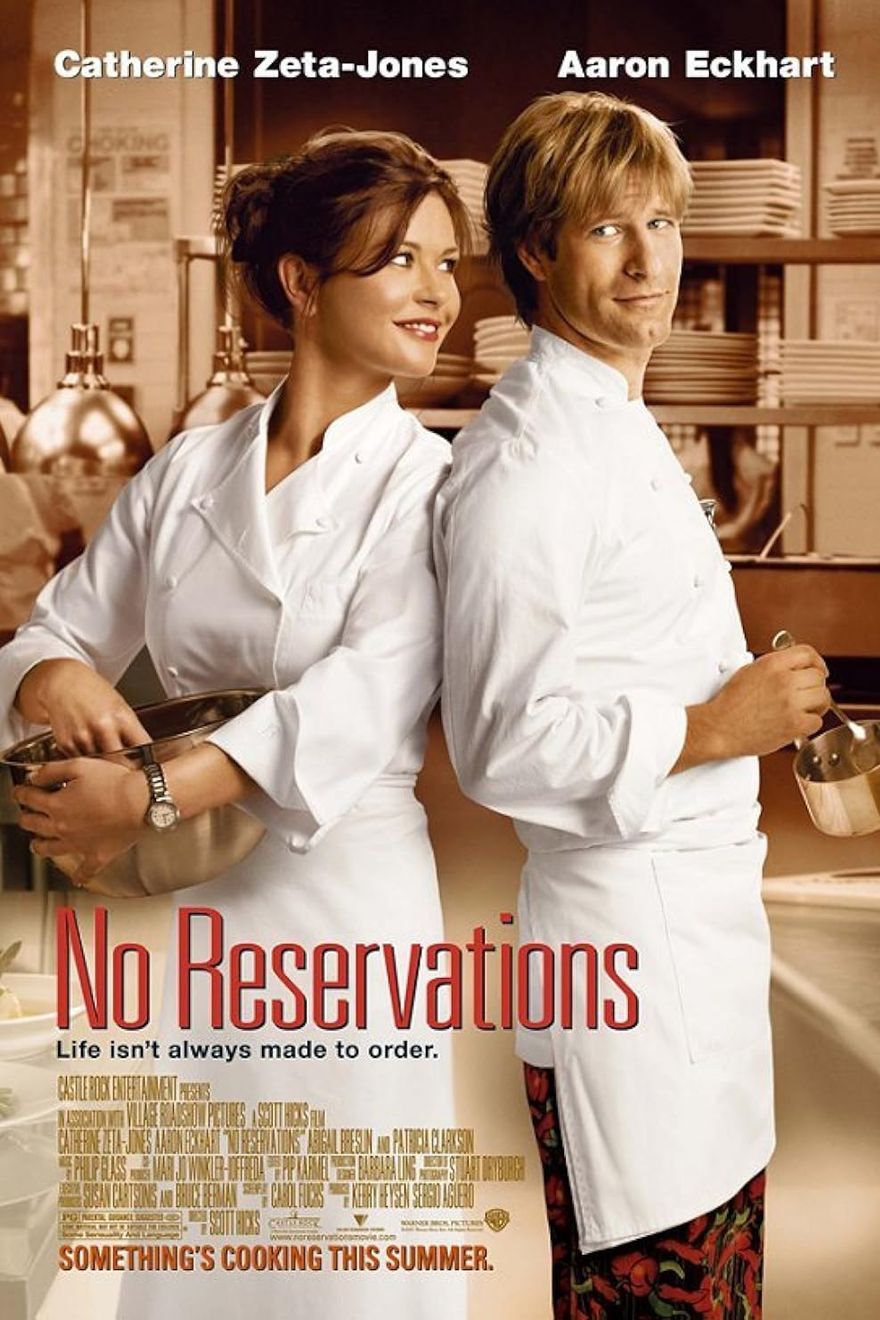
Kate Armstrong can tell you everything worth knowing about a saffron sauce. Ask how she is doing and she will tell you about the saffron sauce.
She runs the kitchen at a Manhattan restaurant, she is exceptional at it, and it is the only sentence she has ever learned to finish. When her sister is killed in a car accident and leaves her a nine year old, No Reservations is clear eyed about what Kate does with that. She cooks at it. She puts scallops in front of a grieving child and cannot work out why the child will not eat them.
The food is doing all the talking
The plates here are photographed with more care than any human face in the picture. Butter goes into pans in close up. Fish arrives at dawn. Someone lifts a cloche and the camera treats it as a reveal, and it earns that, because the food is the only thing in this film operating at full strength.
Which turns out to be the problem. Kate can only express herself through cooking, and the movie shares the limitation exactly. It is fluent, specific and confident whenever there is something on a plate, and it goes vague the second two people have to say something true to each other. Roger Ebert made the point in 2007 that the film runs on two kinds of chemistry, kitchen and heart, and that only one of them works.
There is one nice touch that is easy to miss. Philip Glass scored this, opera runs through a great deal of it, and Nick keeps some of that playing while he works. The music is doing character work as well as mood work. He is the only person in that building who brought a soundtrack to his job.
Kate is the only person here with an interior
Catherine Zeta-Jones is doing real work. The performance is held rather than showy, which suits a woman whose entire personality is control, and she carries the film without ever visibly straining at it.
Nobody around her gets that much. The people in her orbit are shaped to do jobs, and once the job is done they stop developing. That is not a casting problem. It is a script that decided in advance what everybody was for.
Kate is the only one allowed to change her mind.
Why No Reservations feels so predictable
Slow is the right speed for this material. A film about a woman adjusting to a life she did not pick should take its time, and Scott Hicks clearly knows it.
The trouble is what the time gets spent on. Every turn is visible long before it arrives, in the order you expect it, so the room the pacing opens up fills with things you worked out twenty minutes earlier. The film uses its length to confirm rather than to look.
Which is a waste, because the setup is genuinely good. A woman who has built a life she can control, handed a child and a rival in the same week, is a premise with somewhere to go. It goes exactly where you thought.
Should you watch it?
Yes, if the evening is already empty and you want something warm that will not ask much of you. It is handsome, it is generous to its people, and it is never unpleasant to sit through.
Come to it for the kitchen and not for the romance. The kitchen is where this film is awake.
Two and a half bulbs, which on this scale means a mess you can happily sit through, and this one is far more watchable than it is a mess.
Two things land late, and both land flat.
The first is the fight. Kate corners Nick in the walk-in and accuses him of manoeuvring for her job, and it turns out he had already turned the offer down. She learns this from a voicemail. A film that spent ninety minutes building a professional rivalry disposes of it off screen, through an answering machine, while the person it matters to is asleep. It is the softest available exit from the best conflict the film had.
The second is where Zoe goes when she runs. She has already said out loud that she wants to be with her mother, so when she disappears and the adults start asking each other where a nine year old could possibly have gone, the answer has been sitting in the room for twenty minutes. She is at the grave. The scene is played for devastation and arrives as arithmetic, which is a shame, because it is the only moment in the film with real weight underneath it.
Then everybody opens a bistro together and the credits roll.
Bright Bulbs
- It will make you hungry inside ten minutes and keep you there for two hours. Do not start this one on an empty stomach.
Dull Bulbs
- Aaron Eckhart is charming and does nothing wrong. Nick is a personality rather than a person, and the film never asks him to be more.
- Abigail Breslin is perfectly good. The grief thaws on schedule rather than for a reason, which is the script's doing and not hers.
- Bob Balaban's therapist is there for the laugh and eats extremely well for it. He is credited as Therapist, which is about the depth available.
Shattered Bulbs
- Slow by design and slack in practice. The pacing makes room the film then has nothing to put in it.
- There is nothing here you have not seen assembled this way before, including the beat meant to break your heart.
Cast
- Catherine Zeta-Jones as Kate Armstrong
- Aaron Eckhart as Nick Palmer
- Abigail Breslin as Zoe Armstrong
- Patricia Clarkson as Paula
- Bob Balaban as Therapist
- Brían F. O'Byrne as Sean
- Arija Bareikis as Christine Armstrong
- Lily Rabe as Bernadette
- Jenny Wade as Leah
- Zoë Kravitz as Charlotte