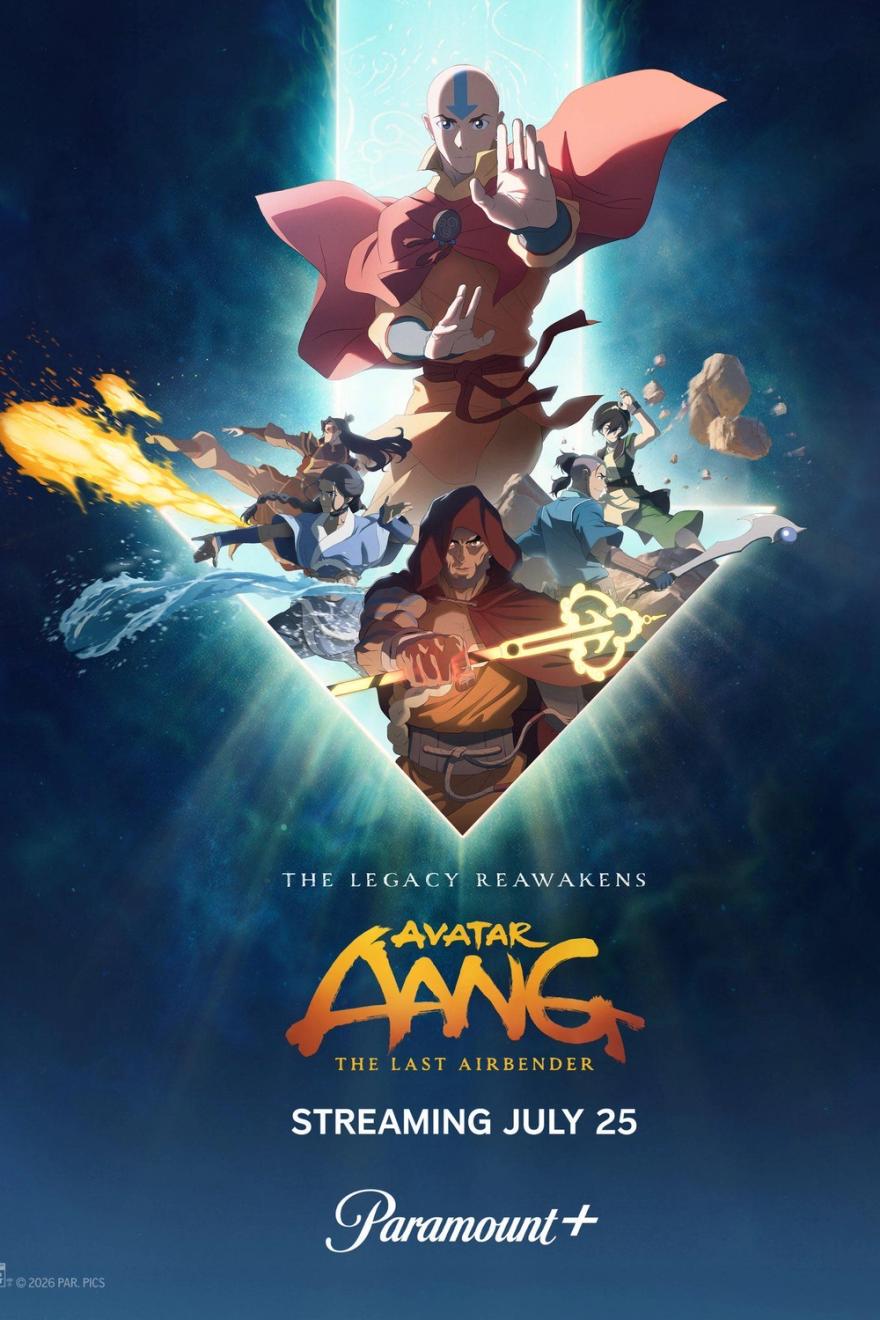
Aang grew up. So did everyone else, and that turns out to be the problem.
Thirteen years after the Hundred Year War ended, the last Airbender is combing through the ruins of his own temples looking for anything of his people that survived. Then he finds another airbender frozen in the ice, and the film has its engine. What it does with that engine is the question, and the answer is: less than you want, wrapped in some of the most beautiful animation the franchise has produced.
Most of what works here works because you already care
This is not a film for newcomers, whatever Paramount says. Almost everything that lands here lands because you already care. Strip out twenty years of affection for these people and what remains is a competent fantasy action movie about a sad man looking for a magic stick.
If you have seen the original series, though, it works on you constantly. The cabbage merchant is back and his cart still suffers. The old comic register survived the jump intact, and the gag about how Aang saved the world, told over images of a baby beside a man built like a monument, is the funniest thing in the film. The humour thins badly in the middle stretch, but the opening half hour is genuinely delightful.
Who's who
Aang (Eric Nam) carries the film alone. Tagah (Dave Bautista) is the airbender in the ice. Katara (Jessica Matten) is watching over Republic City, Zuko (Steven Yeun) is rebuilding the Fire Nation, Sokka (Román Zaragoza) is inventing again, and Toph (Dionne Quan) is running the first metalbending academy. Avatar Sonam (Freida Pinto) and Avatar Xian (Ke Huy Quan) are past lives created for this film. Kallik (Geraldine Viswanathan) belongs to the Denied, a non-bender group with a grievance.
Airbending was never the culture
Here is where the film earns its existence, and it does it so quietly you could miss it.
Aang spends the whole story believing his people can be restored if airbending returns. The film gently disagrees with him. Airbending was one practice among many. The culture was the guidance the monks gave, the way children were raised, the way an entire civilisation was taught to hold itself. A civilisation is the people who keep its practices, not the people who inherit its powers. Nothing about that requires a single bender. It requires someone willing to live that way, and the film knows it long before Aang does.
There is a line in here about roaming the world and then becoming the mist that travels through it, and it is the best writing in the movie. It is also gone in about four seconds. That is the film's whole habit: the profound thing gets a whisper, the chase for the artefact gets the reel.
Everybody stands around
The founders of Republic City show up to be reassured that they are still friends.
Zuko does almost nothing. Toph runs an academy the film has no time to visit, gets a partial suit of metal armour that protects her head and roughly nothing else, and has been given a long flowing mane. There is one windy scene where the hair billows out from under the helmet and she stops resembling the greatest earthbender alive and starts resembling a Digimon. Anime has been drawing that exact silhouette for thirty years. It is not the one you want for Toph. Katara gets one magnificent sequence where she parts a working section of ocean, and Sokka gets the jokes, and that is the extent of it.
At ninety-nine minutes, something had to be cut. What got cut was four of the most beloved characters in modern animation.
The animation is stunning in bursts rather than throughout, and that distinction matters. The temple coming down over Republic City is a genuinely extraordinary piece of filmmaking, the flashbacks are gorgeous, and then the film cuts to something ordinary and you sit waiting for the next one. It arrives, and then it goes again. The film opens like something built for a cinema and ends like something you can watch on a television, provided the television is reasonably large.
The verdict
Three out of five. GLOWING, and honestly it sat at 2.5 for a while. The extra half is the film riding on the coattails of the series that made it possible. It leans on that goodwill constantly, and it mostly gets away with it.
Good fan service that could have been better. If you loved the show, you will find enough here. If you didn't, there is nothing in this for you.
Tagah is the villain, and he was put in the ice on purpose. He was sealed away by Avatar Sonam because he wanted to build an Airbender Empire and wipe out the other nations. Aang finds him and hears a survivor. What he actually found was the reason a previous Avatar decided some things should stay frozen.
His grief is the point. Tagah is Aang with the trauma left to rot. Same loss, same survivor's guilt, and a hatred of the other nations that turns out to be self-hatred pointed outward, because he could not save his own people either. He does not want Air Nomad culture restored. He wants airbenders. The distinction is the film's entire argument, delivered through a man who gets it exactly backwards.
The Denied get airbending, and this is where the film breaks. Tagah grants bending to a group of non-benders who then use it with precision almost immediately. Both prior series spent years establishing that bending is difficult, that even gifted students struggle, and that mastery costs something. Here it costs an afternoon.
Team Avatar loses, badly. Katara, Zuko and Toph fought a hundred-year war and have feats on record that this film seems unaware of. They go in confident and get taken apart. Toph cannot metalbend a damaged ship properly, which she was doing harder things than in the show. Zuko is nerfed to the point of decoration. Katara hauls the group back from nearly dead by performing her waterbending voodoo, which the franchise insists on calling healing.
The climax. Tagah uses Sonam's staff at the temple of Jharana to force himself into a godlike state, corrupted by his own rage, and attacks Republic City. Aang turns one of Tagah's own moves against him, takes the staff and boosts himself the same way, and comes out looking serene rather than monstrous. He very nearly kills Tagah anyway. What stops him is a scrap of airbender cloth drifting into view and the memory of Gyatso, and the understanding that his people would not have wanted this.
Kallik defects. After watching the attack on the city she pulls a civilian out of the rubble instead of fighting. She loses her airbending when the staff is destroyed and joins the Air Acolytes anyway, which is the film quietly proving its own thesis. She kept the culture without keeping the power.
The sky bison. Sonam tells Aang about a hidden valley, and in the epilogue the group finds a surviving herd. Appa is not the last of his kind. The Legend of Korra always said Aang found them; this is the first time anyone has shown it, and it is a lovely place to end.
I want one.
Bright Bulbs
- The animation, in bursts. The temple falling on Republic City and the flashback sequences are out of this world, and then the film cuts away and you wait for the next one.
- The idea about culture. Airbending was a practice, not the civilisation. The civilisation was the teaching, and teaching survives without a single bender. It is a genuinely moving thought and it arrives at exactly the right moment.
- Aang has somewhere to go. The Avatar is still gullible after everything, and it is earned rather than lazy. When your entire people are gone, you follow any shimmer of hope you are offered.
- The jokes that survived. The film's account of how Aang saved the world cuts between a small boy and the enormous man he grew into, and it is the funniest thing in the movie. The cabbage merchant's cart is still having a terrible time.
Dull Bulbs
- Katara. One magnificent ocean-parting sequence, and then back to standing behind Aang.
- Zuko. Rebuilding an entire nation, all of it off screen.
- Toph. Runs the first metalbending academy in history. The film never visits it.
- Sokka. Reliable for a laugh, and that is the whole job.
- Avatar Roku. All that personality in the series, and here he is basically a museum hologram.
- These four built Republic City, and fifty years later a whole civilisation is still living inside what they made. On the evidence here they belonged in Shattered. They are sitting in Dull because of who they were in the original series, and there is a limit to what I am willing to do to them.
Shattered Bulbs
- Instant expert airbending. The Denied receive bending and are wielding it accurately almost at once. Two prior series built their world on bending being hard. This undoes that in a single scene and never acknowledges it.
- Tagah is not much of a villain. Trauma, revenge, and very little else. He is intended as Aang's shadow and mostly functions as an obstacle with good bone structure, a fact the film makes a joke about without ever quite deciding what the joke is.
- The pacing is all over the place. Long detours sit next to hard cuts. Avatar Sonam gets a stretch of screen time to muse about a tree and her toenails in a ninety-nine minute film that then has to sprint. In a ten-episode series that indulgence is charming. Here it is stolen from the story.
- Too much spirit world. Korra devotees will be at home. Everyone else will check how long is left.
Cast
- Eric Nam as Aang
- Dave Bautista as Tagah
- Jessica Matten as Katara
- Roman Zaragoza as Sokka
- Steven Yeun as Zuko
- Dionne Quan as Toph
- Freida Pinto as Avatar Sonam
- Ke Huy Quan as Avatar Xian
- Geraldine Viswanathan as Kallik
- Ken Jeong as Cabbage Merchant
- Taika Waititi as Gorillavark
- Ronny Chieng as Fire Nation Messenger
- Keone Young as Avatar Roku
- Dee Bradley Baker as Appa / Momo
Related quiz
More from Avatar: The Last Airbender
Which Bender Are You?Fire, water, earth, air or a great personality? Ten everyday problems reveal how you meet trouble. No powers or lore needed.