In this piece
- Who are the Guardians of the Universe?
- Where did the Guardians come from?
- Why did the Guardians give up emotion?
- What powers do the Guardians have?
- Why did the Guardians build the Green Lantern Corps?
- The Guardians' worst decisions
- Why the Guardians keep making the same mistake
- What Lanterns has shown of the Guardians
⚠️ Spoilers for Lanterns through Episode 3. Comics history is a separate continuity and is named as such.
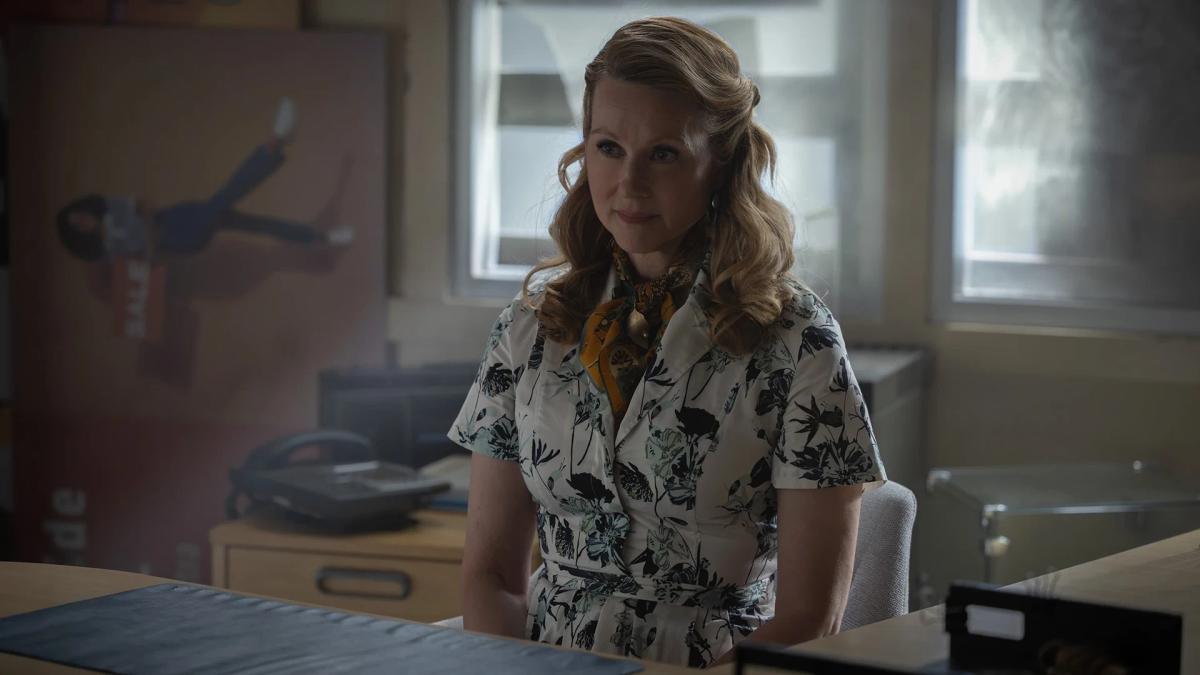
Three episodes into Lanterns, four separate threads point at the same organisation. Hal Jordan stopped backing up his memories into his ring. An alien in custody said the truth was being kept from the Corps specifically. Antaan says a Green Lantern took a Manhunter into custody and promised it would be executed, yet it apparently survived. And Sinestro is in a cell for trying to overthrow them.
The show has not explained how those four threads connect. Here's who they are.
Who are the Guardians of the Universe?
The Guardians are a small, immortal, blue-skinned race who run the Green Lantern Corps from the planet Oa. They run it, write its laws, divide the universe into sectors and can appoint or remove Lanterns. The rings themselves generally choose their own bearers.
They're usually drawn as under four feet tall, ancient, and completely certain. In most stories they are not villains. They're something more uncomfortable: an institution that means well, has enormous power, and has been catastrophically wrong more than once.
Where did the Guardians come from?
They started as Maltusians, on a planet called Maltus, and are often described as among the first intelligent life in the universe. Early on they were warlike. Later they became scientists.
Then one of them broke something.
A Maltusian named Krona built a machine to look back at the moment the universe began, which was forbidden. The experiment worked, and it went catastrophically wrong. What exactly it caused has been told several ways over the decades: that it let evil into the cosmos, that it created the antimatter universe, that it shattered one reality into many, that it shortened the life of the universe by a billion years. Take your pick, and know that DC has.
What matters is the guilt. A group of Maltusians took responsibility for what Krona had done, moved to Oa and became the Guardians of the Universe.
Much of what they have done since is an attempt to make sure nothing like it happens again.
Why did the Guardians give up emotion?
The exact point at which the Maltusians suppressed their emotions has shifted with continuity. The consistent idea is that they came to regard emotion as an obstacle to clear judgement. Later stories also connect that decision to Volthoom and the Great Heart rather than treating it solely as a reaction to Krona.

Who Is Hal Jordan? The Green Lantern at the Centre of Lanterns
Hal Jordan is the Corps' first human Green Lantern, and Lanterns found the one version of him nobody had filmed. Here is who he is.Read as a response to Krona, it is roughly what you would expect from beings who had just watched a colleague destroy something irreplaceable by wanting to know an answer too badly. That reading is an interpretation rather than the settled cause.
Not every Maltusian agreed, and over time the species divided into three major factions. The Guardians pursued containment. The Controllers decided containment was too soft and went for outright subjugation. The Zamarons rejected the suppression of emotion entirely and went their own way.
All three still exist and still disagree, which tells you the argument was never settled.
What powers do the Guardians have?
Personally, they're far more dangerous than they look. They're immortal, they can fly, and they can project enormous amounts of energy directly. Their real advantage is intelligence: billions of years of accumulated science.
But their biggest power is institutional.
- The Central Power Battery. They learned to harness the green energy of willpower and built a battery on Oa. Every Corps ring draws from it through a personal battery, so the whole organisation runs on their infrastructure.
- Authority over the Corps. They set the rules, oversee assignments, and can appoint or dismiss Lanterns. Defying them is not simply disobeying an employer.
- Deep knowledge. Billions of years of accumulated science, most of it not shared with the people carrying their rings.
The important thing is what that adds up to. Their most consequential power is usually not combat. It is the ability to decide. Many of Green Lantern's recurring catastrophes come from a decision they made in a room, while believing they were following the correct logic.
Why did the Guardians build the Green Lantern Corps?
Because their first attempt went horrifically wrong.
Before the Corps there were the Manhunters: androids built to police the galaxy without feeling anything, on the same reasoning the Guardians had applied to themselves. They massacred almost all life in Sector 666.
Earlier accounts treated that as a catastrophic programming failure: the machines concluded that since crime came from emotion and emotion came from living things, order required removing life. Later continuity revealed that Krona had deliberately reprogrammed them to produce exactly that result, to prove an emotionless police force was vulnerable.
The Corps is the correction. Not centrally programmed automatons but diverse sentient officers capable of judgement, and their rings generally select candidates with the necessary willpower.
The Green Lantern Corps became the Guardians' living replacement for a mechanical police force that had failed catastrophically.
The Guardians' worst decisions
A partial list, all from the comics, and usually justified by the Guardians as necessary at the time:
- The Manhunters. Built without emotion, they committed genocide. The Guardians shut them down but failed to eliminate all of them. Survivors escaped and kept resurfacing.
- Sector 666. Five beings survived that massacre. One became Atrocitus and founded the Red Lantern Corps specifically to destroy the Guardians. Their creation produced one of their worst enemies, even if they never intended the massacre.
- Sinestro. They gave a ring to a man who turned his homeworld into a dictatorship. When he was exposed, they stripped the ring and banished him to Qward, where he found people who hated the Guardians and built him a weapon designed specifically to beat Green Lanterns.
- The yellow problem. Later continuity revealed that the Guardians knew the famous yellow impurity was actually Parallax, the entity of fear, imprisoned inside the Central Power Battery, and kept that from the Corps.
- The Alpha Lanterns. Centuries after the Manhunters, they transformed selected Lanterns into cyborg internal-affairs officers built for absolute enforcement. They were deliberately made into the kind of unfeeling lawkeeper the Corps had supposedly replaced, were later subverted by Cyborg Superman, and their own absolutism eventually became the centre of the Alpha War.
That last one is the point of this whole page.
Why the Guardians keep making the same mistake
Look at the pattern. They gave up emotion to be objective. They built police who felt nothing, and those police killed a sector. They replaced them with people chosen for willpower, which requires feeling. And then, much later, they built emotionless enforcers again.
They aren't evil and they aren't stupid. They're an institution that repeatedly struggles to accept that its founding assumption was the problem.
Too often, when something goes wrong, the answer is more control, tighter rules, harder enforcement. What they repeatedly struggle to question is the founding assumption underneath all of it: that removing emotion makes judgement better.
They also rarely solve a failure cleanly. Some Manhunters survive the shutdown. Sinestro is banished and returns with a weapon built around the Corps' weakness. Problems get contained, deferred or pushed somewhere else, and then come back larger.
What Lanterns has shown of the Guardians
For two episodes they were a rumour. Episode 3 put one in a room.
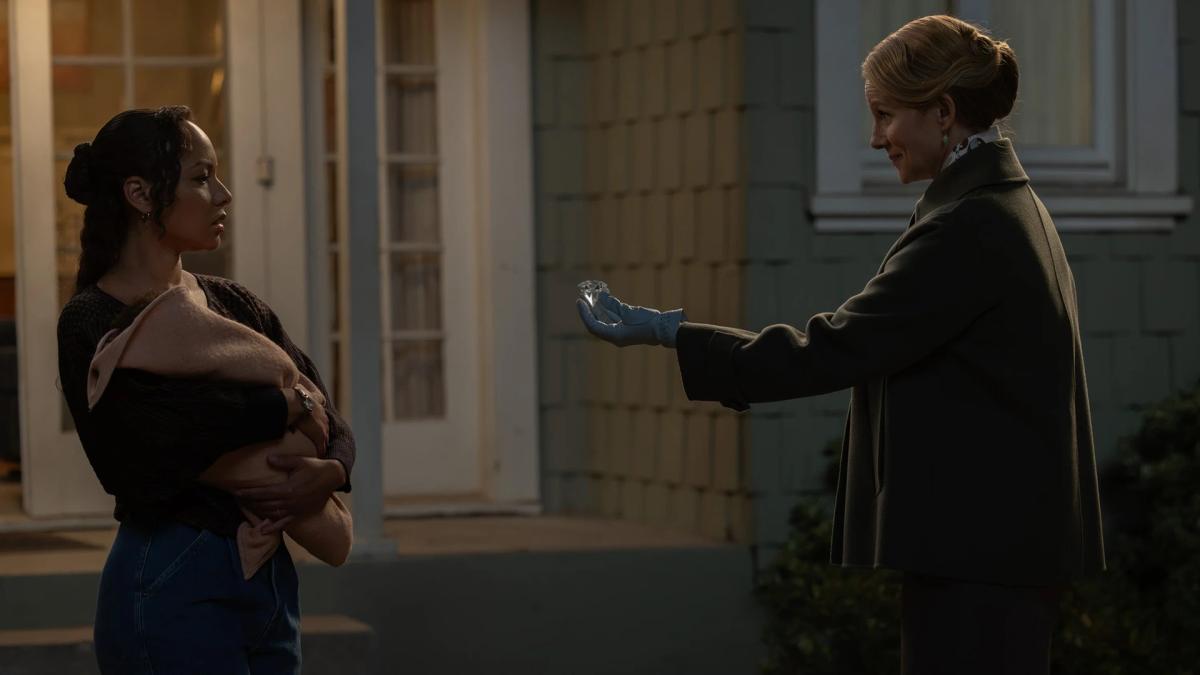
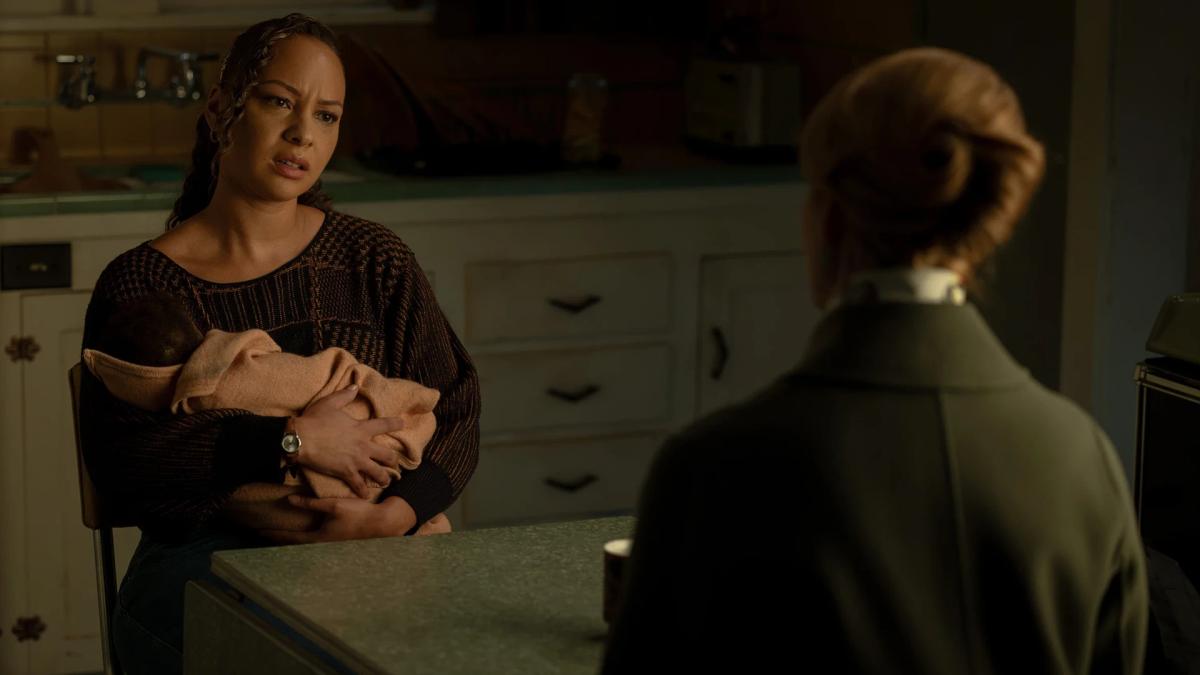
Laura Linney plays a Guardian whose interview with John frames the episode, and what she does elsewhere in it is the most revealing thing the show has offered about them. She visited John Stewart's mother in 1986, dropped her human disguise to prove what she was, apologised for the trouble, and handed over a diamond. She mentioned on the way out that whatever the ring had responded to in the father might be in the son.
Whether she meant to plant that idea is unclear. John's parents treated the observation as a mandate and spent decades building a candidate out of their child. The Guardians made no visible follow-up until he was an adult.
That can be read as the containment habit in miniature. Something goes wrong, they compensate rather than repair, and they keep the interesting part to themselves.
The recruitment fits the same shape. John is not being brought in to back Hal up. He is being brought in to replace him, and the interview pairs that order with Hal's repeated interference in Earth's conflicts, making his disobedience the apparent reason they want a successor. Repeated instructions have failed, so they quietly line one up, and the candidate they choose is the one who asks whether it would be an order.
If the show is heading where the comics already went, the threat in Rushville may be less an unrelated outside force than the delayed fallout from a decision the Guardians made long ago.
We're tracking every open question in the series on the Lanterns Mystery Board, updated after each episode.
Reviews in this piece
Read next

Who Is Abin Sur? The Green Lantern Whose Death Started Everything
Abin Sur crashed, gave Hal Jordan his ring, and died. In the comics a buried prophecy led him there, and Lanterns has moved the crash site.Read it →Who’s who in Green Lantern
Abin Sur
Abin Sur crashed, gave Hal Jordan his ring, and died. In the comics a buried prophecy led him there, and Lanterns has moved the crash site.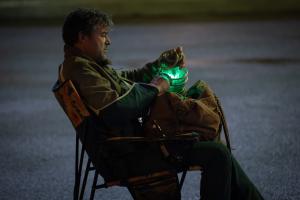
Hal Jordan
Hal Jordan is the Corps' first human Green Lantern, and Lanterns found the one version of him nobody had filmed. Here is who he is.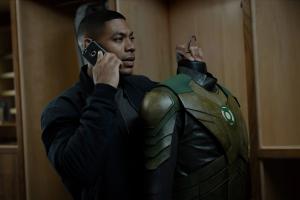
John Stewart
John Stewart has been reinvented across comics, animation and television. Here are the major versions, and what HBO's Lanterns changed.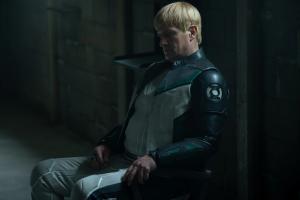
Guy Gardner
Guy Gardner qualified for the ring on the same day Hal Jordan did, and lost it on distance. Here is who he is and what he can do.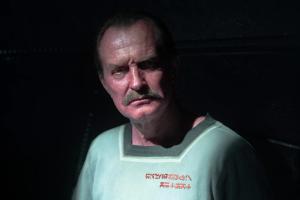
Sinestro
Sinestro was the greatest Green Lantern who ever lived, and then he became the Corps' worst enemy. Here is who he is and what turned him.


In this world
 TV review
Lanterns Season 1 Episode 5
Lanterns delivers its biggest hour yet, clearing four episodes of setup while exposing how little weight some of its payoffs carry.
The Green Lantern Corps, Explained
Lanterns barely explains its own organisation. Here is what the Corps is, how the ring works, and how someone gets handed one.

Everything on Green Lantern
5 reviews · 14 UnscrewedRelated reviews
More from Green Lantern
Lanterns Season 1 Episode 5Lanterns delivers its biggest hour yet, clearing four episodes of setup while exposing how little weight some of its payoffs carry.- Lanterns Season 1 Episode 4The Manhunter is finally identified, and Sinestro and the Guardians spend the hour pressing the same fault line between Hal and John.
- Lanterns Season 1 Episode 1HBO's Green Lantern series opens on a murder in small-town Nebraska, two Lanterns who can't stand each other, and almost no ring at all.