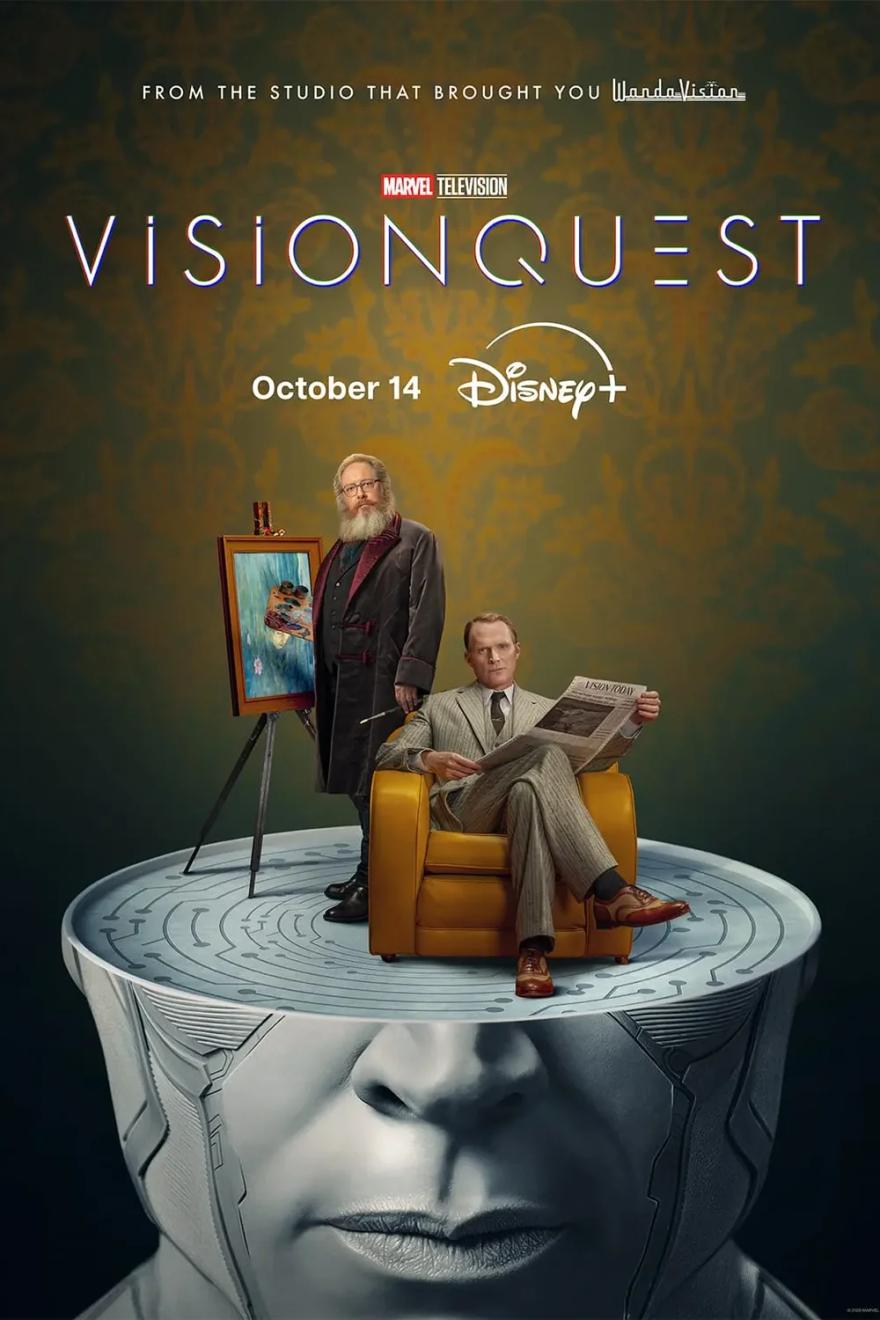
Episode 7 is where you realise why the show is called VisionQuest: it's a quest for Vision (Paul Bettany) to understand who he really is. As a lead-in to the finale, it does a perfectly good job.
The problem is how long it took to get here. It takes six episodes for Vision to face himself, and the build-up was too slow.
Paul Bettany as Vision
Bettany does really great work in this episode. In a nutshell, VisionQuest is about Vision confronting who he is and what his family means to him, and Episode 7 is where that confrontation happens. Vision has spent the season keeping his feelings at arm's length, and Bettany has to show a machine finding out how much he feels. The episode gets its power from watching him do it.
An AI evolving into something like this is quite strange. Vision was built with the Mind Stone, so you'd expect him to be really logical. Instead he behaves like someone built around a heart, and that's kind of touching and kind of strange.
Vision, grief and mental health
The episode isn't just about an AI dealing with himself. It also has a lot to do with people's mental health. We see it that way, at least; we can't say whether the makers meant it.
Some people are not expected to display any emotions. They're expected to be really rough and really rugged. Here, the show puts that expectation on a machine that's supposed to run on probabilities and data models, and that makes Vision's struggle so moving. We like to think his code has become so advanced that it has turned into something like human emotion and human values. The episode doesn't explain it; that part is our reading.
Episode 7 is also where the show's structure makes sense to us. VisionQuest plays like a mirror world for where AI is now and where it might go. We think the makers built it that way to make the show feel current, and it does. Its pictures of code, of deals between programs and of AIs talking to each other work well for us as metaphors, even though real software doesn't look like this.
Wanda, Vision and the MCU's grief
The Marvel universe has now given its emotional weight to this one family. Think of the MCU's most emotional scenes: Tony Stark (Robert Downey Jr.) sacrificing himself, Black Widow (Scarlett Johansson) sacrificing herself, Captain America (Chris Evans) living with his grief over Peggy, Hawkeye (Jeremy Renner) crying over Black Widow, and Thanos (Josh Brolin) killing Gamora (Zoe Saldaña). Tony got a huge funeral and Captain America got his sweet ending. Black Widow never got a funeral like Tony's, and we didn't like that.
Wanda Maximoff (Elizabeth Olsen) never had a film of her own, but she had such a strong presence that she lifted every film she was in. By the end of Avengers: Endgame, her grief got very little attention: a moment with Hawkeye after Tony's funeral, and not much more. Her brother was already dead. When she finally had love, she had to kill Vision to save the world, then watch Thanos bring him back only to kill him again. Then she brought him back herself, in WandaVision, and lost him again. Can you imagine the grief?
Vision has been carrying his share of it too. He sacrificed himself, was killed, had his body taken apart by S.W.O.R.D. for experiments, and was put back together and switched on again, but not the way he was. That entire crushing weight is too much, and Wanda and Vision's family is now the grieving family of Marvel.
What to watch before VisionQuest Episode 7
The show does show that weight in places, but it works better if you already know all of it. To feel the full force of this episode, it helps to have watched Avengers: Age of Ultron, Avengers: Infinity War, Avengers: Endgame, WandaVision and, to some extent, Agatha All Along. Our VisionQuest watchlist gives the order for the essentials. It treats Endgame as optional, but Endgame adds to the weight here.
The pace of VisionQuest Episode 7
The long build-up of Vision going down in the lift is too much. There are two ways to look at it. You could cut a lot of this show and make it a TV movie of sorts, or a proper limited series of six episodes instead of eight, and that would work too. But the way the story develops and the characters behave makes the payoff worthwhile, slow build-up and all.
Paladin and the villains
Paladin (Todd Stashwick) was supposed to be a villain and has turned into an anti-hero. The other villains are a different matter. Their connections are still hard to piece together, and even if the finale answers that properly, we don't think the show has set it up well enough for most viewers.
Is VisionQuest Episode 7 worth watching?
Yes. Episode 7 is one of the saddest of the season, and the ending is very strongly done.
WandaVision's first episode was 1% reveal and 99% everything else, and its last episode was 99% reveal, with everything coming together. Given how VisionQuest has built up and how Episode 7 ends, the finale should be a very nice payoff.
Our review of Episodes 5 and 6 covers how the show got here.
The Synthetic Man. The episode opens on Phineas Horton (Paul Bettany) selling his family estate to build J.I.M., a synthetic man to replace the son he lost. His wife leaves with their daughter, telling him she hopes he one day builds something that knows how to love him back.
Saving Lisa. The nanobot inside Lisa Molinari (Lauren Morais) can't be removed without killing her, so Vision (Paul Bettany) and Tommy (Ruaridh Mollica) need a way to reprogram it before it takes her over completely.
F.R.I.D.A.Y.'s call. F.R.I.D.A.Y. (Orla Brady) calls from inside the mind of Jocasta (T'Nia Miller). She has disguised herself as a bot, and she warns them about the nanobots Jocasta has locked away.
The nest. At the grave of Jo Carrington's human body, Ultron (James Spader) supplies the fourth key, the face scan of Katerina Wells (Mary McDonnell), and Jocasta recites Poe's "The Raven" for the fifth. A sixth lock asks for a key from a partner she has forgotten.
The Client's offer. The Client offers Vision the source code that can save Lisa, buried deep in his own mind, in exchange for a directive written into his core: once Lisa is saved, Vision must surrender to Paladin, or his core systems will fail. He offers Jocasta her memories back. Ultron laughs at him. When Lisa wakes, calls for Thomas and collapses, Vision accepts.
The power source. Digging that deep into his code needs enormous power. Paladin (Todd Stashwick) brings the blade from Corvus Glaive's staff, the weapon that stabbed Vision in Avengers: Infinity War, taken from Wakanda, and Vision uses it as a power cell. Getting it has cost Paladin his relationship with Wakanda.
Down the lift. Vision rides the lift down through his memories. He finds Ultron, who is watching WandaVision and tells him that family is forever. Then he meets the original Vision, who insists they aren't separate, that he is Billy and Tommy's father, and that only fear is stopping him. Vision blasts him with a laser, and the lift keeps sending him back.
J.I.M. and Phineas Horton. At the bottom he finds J.I.M. (Paul Bettany), the first synthetic man, and Horton. Horton built J.I.M. to feel nothing, but J.I.M. wanted to feel, and when he fell in love he burned so fast that he set fire to everything around him, his creator included. Vision, it turns out, wears J.I.M.'s face.
The Vision. J.I.M. says the source code was in Vision all along. Vision finally says it: he lost Billy, he lost Tommy, he lost Wanda. He accepts that he is the Vision, and J.I.M. tells him that finding his way through the pain has made him a "real boy". With the code, he saves Lisa.
Why Vision hid. For us, this is the heart of the episode. Calling himself a copy, just a machine and computer code, let Vision keep those memories locked away. He was grieving so much on the inside that he didn't want to talk about it or bring it to the front. Accepting Tommy as his son means admitting everything he lost: Billy, Tommy and Wanda. When it all hits him, you realise it was never just Wanda dealing with that grief.
The message. The directive kicks in. Vision leaves Thomas a tablet with a message calling him his son and telling him he loves him, along with the WandaVision footage of their family. Then he leaves with Paladin to surrender. He loves his son so much that he gave up control of his own code to save the person Tommy loves, and you can feel Tommy being left there.
F.R.I.D.A.Y. and Ultron. Meanwhile, Jocasta and Ultron go into her memories and find the same loft that sits in Vision's mind, passed down somehow by the creators of AI. F.R.I.D.A.Y. follows them in disguise. Near the end, when she realises the man in Jo's memories has Ultron's face, Ultron throws her off the loft balcony.
The Client. Armed men shut down Jocasta at the grave and Vision outside the Horton house, and Paladin's truck is hit by a rocket as he drives away. The Client turns out to look exactly like Ultron's human form, and to have been Jo Carrington's partner. The Client appears outside the house, where Vision lies unconscious.
What we'd like from the finale. We don't think Jocasta will turn out to be the real villain; she may turn on the others. Our guess is that Ultron is the big baddie, though the show hasn't confirmed it. We hope F.R.I.D.A.Y. hid a copy of her code while she was undercover as a bot, and that J.A.R.V.I.S. (James D'Arcy) comes back too. Paladin has gone from villain to anti-hero, and he may end up something like a hero. We'd love to see Billy appear, Tommy use his powers to come to Vision's rescue like he did before, and the family get its big moment. They could even go looking for Wanda, and end up living together somewhere, maybe on an island.
Read next, with spoilers
Also in Marvel Cinematic Universe
Doctor Doom Wakes Wanda: VisionQuest's Credits Scene ExplainedVisionQuest ends with Doctor Doom waking the Scarlet Witch. What the scene shows, the comics behind it, and what it means for Avengers: Doomsday.- The Most Powerful AIs in the MCU, RankedFrom D.U.M.-E. to Ultron: AIs from the MCU's main universe and the TVA, ranked by what each one can actually do, VisionQuest's included.
- Adamantium vs Vibranium: Which Is Stronger in the MCU?VisionQuest put adamantium bullets through Vision's vibranium body. What each Marvel metal is, where it comes from, and which one is stronger.
- Who Is J.I.M. in VisionQuest? The Synthetic Man and Marvel's First Human TorchThe first synthetic man in VisionQuest burned up from feeling too much, and Vision wears his face. How he links to Marvel's original Human Torch.
- Who Is the Butcherbird in VisionQuest? Jocasta ExplainedThe killer synthezoid with a dead scientist's mind, her love story with Ultron, how VisionQuest ends for her, and Jocasta in Marvel's comics.
- VisionQuest and Real-World AI: Why Vision's Story Feels So Close NowVisionQuest's AI ideas aren't new. Watching them in a world of chatbots and deepfakes is, and that's why the show feels so close to home.
Bright Bulbs
- Paul Bettany (Vision) does some really great acting work as Vision faces his grief.
- The episode shows what the quest in VisionQuest really is.
- A machine built with the Mind Stone ends up running on feeling, and it's touching.
- The episode sets up the finale well, and the ending hits hard.
Dull Bulbs
- After six episodes, the build-up to this point was too slow.
- The long trip down through Vision's mind could have been much shorter.
- How the villains connect is hard to follow.
- It works best for viewers who know the films and WandaVision.
VisionQuest Season 1: episode reviews
Cast
- Paul Bettany as Vision
- Ruaridh Mollica as Tommy Maximoff / Thomas Shepherd
- James Spader as Ultron
- T'Nia Miller as The Butcherbird
- Todd Stashwick as Paladin
- Lauren Morais as Lisa Molinari
- Orla Brady as F.R.I.D.A.Y.
- Emily Hampshire as E.D.I.T.H.
- Henry Lewis as D.U.M.-E.
- Jonathan Sayer as U.