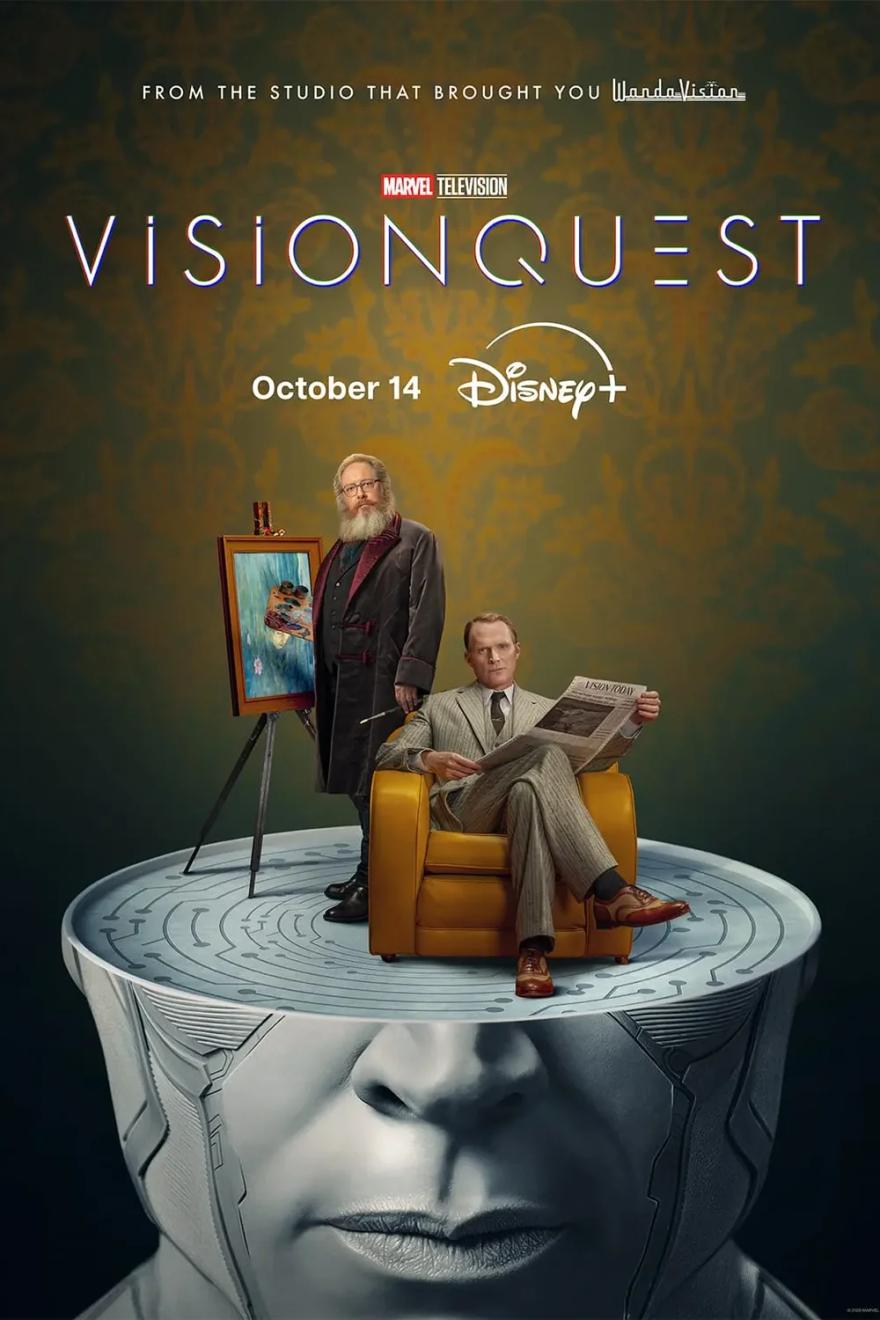
The title tells you what the show is: the quest of Vision becoming Vision. When the season stays with that, with Vision (Paul Bettany), the son he won't call a son and the family he lost, it works. The villains laid over the top of that story are where it goes wrong.
Too little of the season's eight episodes belongs to that story.
What VisionQuest Season 1 is about
VisionQuest is about a machine learning to be a person, and a father. This Vision is the white one that the government agency S.W.O.R.D. rebuilt in WandaVision after the first Vision died. He has the first Vision's memories and says he feels nothing about them, and he's living in Edinburgh under a fake name. Inside his head is a house where Tony Stark's old AIs live, and Ultron (James Spader) is kept in its attic.
A bounty hunter comes for him, and the hunt brings in Tommy Maximoff (Ruaridh Mollica), a young man with the memories of one of the twin sons Wanda and Vision had in WandaVision. The season doubles as a story about AI: something hugely powerful that remembers everything and isn't expected to feel any of it.
VisionQuest has been billed as the last part of a trilogy that began with WandaVision and continued with Agatha All Along.
Paul Bettany and Ruaridh Mollica's performances
The acting is the season's strength. Nobody in the cast is lagging, and Paul Bettany and Ruaridh Mollica are both doing a great job. James Spader's Ultron doesn't steal the show; he's on the same level as everyone else.
Vision and Tommy are still awkward with each other in Episode 6. That awkwardness is kind of cute, and the two of them are able to sell it. Trust builds between a machine who won't call himself a father and a young man who wants one.
Paul Bettany's work in Episode 7, when Vision lets out the grief he has held back for six episodes, is a really great piece of acting.
The Maximoff family's grief
To some extent, Wanda, Vision and their sons are now the grieving family of Marvel. The entire emotional weight of the MCU has been given to them, and the season is at its strongest when it's about what they've lost.
We also read Vision as a picture of people who aren't expected to show emotion. He was first built with the Mind Stone and is supposed to run on logic, and the feelings come anyway. Seeing him behave as if he had been built with a heart is kind of touching and kind of strange.
The pace of VisionQuest Season 1
The season is too slow for too long. Watch only Episode 1 and you'd lose interest, and Episodes 3 and 4 go back into the AIs' histories when the story should be moving forward. The show properly gets going in Episodes 5 and 6. Our episode scores: 3 for Episodes 1 and 2, 2.5 for Episodes 3 and 4, 3.5 each for Episodes 5 and 6 and Episode 7, and 2.5 for the finale.
Eight episodes was too many. A lot of this season could go. Six episodes, or even a TV movie, would still work.
Too much of it is talk as well. The conversations run so long that you stop listening.
The villains of VisionQuest Season 1
The villains drag the season down. Paladin (Todd Stashwick), the bounty hunter, arrives in the premiere looking like he might have some capabilities. By Episodes 5 and 6 he's the season's jester, a comedic fart bag with nothing sinister left.
Then the season gives Ultron a love story with the Butcherbird (T'Nia Miller), a killer AI. The Client, the unseen figure paying for the hunt, ends up part of it. We could not care less about the three of them.
Those three villains never needed to be in this season. They're an unnecessary superimposition, and something about Vision's quest to find his family and his Wanda would have been better.
Vision's mind and the AI story
In the way it shows Vision's mind, this show is trying to be smart, but it comes off as a bit dumb. The house in his head feels borrowed from WandaVision, where Wanda turned the town of Westview into her own sitcom, crossed with Inside Out: each AI has a job, the way each emotion does in that film. An idea like that is a trap, because a show can try so hard to be smart that people stop liking it. By Episodes 5 and 6, memory is boxes and the firewall is video-game fire, and viewers who don't know how computers store data may wonder what is going on.
The timing is what works. Rogue AIs and nanobots are old ideas, but watching them in 2026, with AI tools in daily use, makes them feel relevant. To us the season holds up a mirror to where AI is today.
VisionQuest and WandaVision
The comparison with WandaVision doesn't help VisionQuest. WandaVision started slow too, but its episodes kept ending on cliffhangers, and for us its ending turned the whole show around and justified the wait. VisionQuest's beginning isn't as good, and after Episode 6 we said that if the ending wasn't worth it, the season would be a total and utter disaster.
After the set-up in Episode 7, the finale is a total letdown. Its plot is super thin, and its climax stops for a sitcom copied from WandaVision. If the plan was nostalgia, we're happy to report it doesn't work. That sitcom ruins the entire season.
You also have to arrive knowing a lot. The plot is easy to follow on its own, but the weight of it comes from Avengers: Age of Ultron, Avengers: Infinity War, Avengers: Endgame, WandaVision and Agatha All Along. That makes the season feel like fan service more than a show for a wider audience. Our VisionQuest watchlist covers what to see first; it treats Endgame as optional, but Endgame adds to the weight.
Budget and action
The show looks held back by its budget. We think the budget is why Vision rarely gets to be Vision: he spends much of the season in human form. The first two episodes have some good action scenes, and by the finale the fights are pathetic.
Is VisionQuest Season 1 worth watching?
Only if you came through WandaVision and Agatha All Along caring about this family. Episodes 5 to 7 are the stretch worth your time, and Episode 7 is one of the saddest episodes of the season.
Everyone else can skip it.
The family story is the season's silver lining. Otherwise, the show was garbage. Only because of that and the performances, VisionQuest Season 1 gets 2.5 out of 5: Dimmed. Without them it would have been a 1.5; it was that bad.
J.A.R.V.I.S. We wanted J.A.R.V.I.S. (James D'Arcy) to come back. In Episode 2, with Vision (Paul Bettany) running out of power, he deletes his own code so the other AIs can keep going. We didn't see him return, and we think his exit was just a happy goodbye.
Ultron takes Vision's body. The strongest hook of the first half doesn't have the gravitas it should. At the end of Episode 4, Vision is losing a fight with the Butcherbird (T'Nia Miller) and hands control of his body to Ultron (James Spader), who locks him and the other AIs out.
Ultron and the Butcherbird. You don't feel any creepiness, even though they behave like one of those psychotic couples, a Joker and Harley Quinn. The Butcherbird turns out to be Jocasta, a synthezoid who says she is the dead scientist Jo Carrington, and from Episode 5 she and Ultron flirt their way through long conversations about what they could do to the world. She's so polished, and the scenes so serious, that you have to think about it to feel any creepiness.
Paladin. What a joke this character becomes. In Episode 6 the bomb threat made by Paladin (Todd Stashwick) turns out to be a bluff, and E.D.I.T.H. (Emily Hampshire) talks the AI who runs his missions into quitting. He finishes the season with a second chance, as a hero of sorts.
Why Vision hid. For us, the heart of the season is here. Through six episodes Vision insists he isn't the Vision Tommy remembers, just a machine with someone else's memories, and we think he keeps up that facade because he is grieving so much on the inside, for Wanda (Elizabeth Olsen) and their sons, that he doesn't want to talk about it. In Episode 7 he rides a lift down through his memories, names what he lost and accepts that he is the Vision. Then he leaves a message for Tommy (Ruaridh Mollica) in which he finally calls him his son, and gives himself up to Paladin as the price of saving Lisa Molinari (Lauren Morais), the young woman Tommy loves.
The Client. The big bad guy the season was hiding is useless. His face stays hidden until the end of Episode 7. He is Virgil Horton (James Spader), Jo Carrington's husband and the man Ultron was modelled on, and he wants to move his own mind into Vision's body. The dance he makes Jocasta do with him is horrible. Ultron kills him in the finale, after Virgil shoots Jocasta.
The finale. After what Episode 7 set up, Episode 8 has very little story. Jocasta dies, and a grieving Ultron sends a swarm of nanobots at London. Vision shuts him inside a simulated sitcom, where whole seasons go by while the swarm is still on its way, and gets through to him. Ultron destroys the swarm as it reaches London, and it isn't shown killing anyone. Even so, the threat never looked convincing to us. The sitcom, a copy of WandaVision, looks bad, and it turns up in the middle of the climax and takes you out of it. The jokes don't work either; they just seem weird.
Tommy and Billy. The brothers' reunion gets barely any build-up. Tommy works out that he can reach his brother by going underwater, and it works. We found that so useless. Billy (Joe Locke) turns up at the end and helps bring Vision back after his core burns out.
The Maximoff men's happy ending. The family getting together is that silver lining. We wanted this family to get a happy ending, and the Maximoff men get one. Vision and his sons finish the season together, and in a way the quest worked: Vision found himself and found his family.
Wanda. Wanda coming back is the season's other silver lining, even with our mixed feelings about how. During the end credits, Doctor Doom wakes her and tells her that her power will be his. She's alive, but she's apart from her family and facing Doom, and for this family it's like the grief can never end.
The AIs. F.R.I.D.A.Y. (Orla Brady) being back is a good thing, and we'd hoped for it. Ultron threw her out of Jocasta's mind in Episode 7, and the finale shows he had spared her. By the end the AIs have left Vision's head and are on their own.
Read next, with spoilers
Also in Marvel Cinematic Universe
Doctor Doom Wakes Wanda: VisionQuest's Credits Scene ExplainedVisionQuest ends with Doctor Doom waking the Scarlet Witch. What the scene shows, the comics behind it, and what it means for Avengers: Doomsday.- The Most Powerful AIs in the MCU, RankedFrom D.U.M.-E. to Ultron: AIs from the MCU's main universe and the TVA, ranked by what each one can actually do, VisionQuest's included.
- Adamantium vs Vibranium: Which Is Stronger in the MCU?VisionQuest put adamantium bullets through Vision's vibranium body. What each Marvel metal is, where it comes from, and which one is stronger.
- Who Is J.I.M. in VisionQuest? The Synthetic Man and Marvel's First Human TorchThe first synthetic man in VisionQuest burned up from feeling too much, and Vision wears his face. How he links to Marvel's original Human Torch.
- Who Is the Butcherbird in VisionQuest? Jocasta ExplainedThe killer synthezoid with a dead scientist's mind, her love story with Ultron, how VisionQuest ends for her, and Jocasta in Marvel's comics.
- VisionQuest and Real-World AI: Why Vision's Story Feels So Close NowVisionQuest's AI ideas aren't new. Watching them in a world of chatbots and deepfakes is, and that's why the show feels so close to home.
Bright Bulbs
- Vision (Paul Bettany) and Tommy Maximoff (Ruaridh Mollica) make the father-son story worth following, from the early awkwardness to the trust that grows between them.
- Paul Bettany is at his best in Episode 7, when Vision finally stops hiding from his grief.
- J.A.R.V.I.S. (James D'Arcy, from Agent Carter) and E.D.I.T.H. (Emily Hampshire, from Schitt's Creek) will make fans of those shows happy.
- F.R.I.D.A.Y. (Orla Brady) and the other AIs are cute, and we worried about losing her.
- The way the AIs sign contracts and do handovers in Episode 7 is shown perfectly well.
Dull Bulbs
- The story didn't need eight episodes, and the show only picks up in Episodes 5 and 6.
- Too much of the season is talk, and the long conversations make it hard to keep listening.
- E.D.I.T.H. does her bit. She's okay in the beginning and okay in the end.
- The pairing of Tommy and Lisa Molinari (Lauren Morais) is fine. Nothing there.
Shattered Bulbs
- The finale's sitcom, copied from WandaVision, brings back none of the nostalgia people hoped for, and it ruins the season.
- Ultron (James Spader) and the Butcherbird (T'Nia Miller) flirt about murdering the world, but she is too polished and the talk too serious to feel creepy.
- The finale gives a key family moment almost no build-up, after a season that built up nonsensical stuff throughout.
VisionQuest Season 1: episode reviews
Cast
- Paul Bettany as Vision
- Ruaridh Mollica as Tommy Maximoff / Thomas Shepherd
- James Spader as Ultron
- T'Nia Miller as The Butcherbird
- Todd Stashwick as Paladin
- Lauren Morais as Lisa Molinari
- Orla Brady as F.R.I.D.A.Y.
- Emily Hampshire as E.D.I.T.H.
- James D'Arcy as J.A.R.V.I.S.
- Henry Lewis as D.U.M.-E.
- Jonathan Sayer as U.
- Diane Morgan as Handler
- Mary McDonnell as Katerina Wells