Before you press play
Watch if
You love The Last Airbender and The Legend of Korra and want to see where their world ends up 225 years later.
Wait if
You want the politics and big bending fights of the earlier shows. This one is pitched much younger, and its action is weak.
Avatar: Seven Havens has a great premise and an uneven first season. Two Avatars alive at the same time, and they are twin sisters: that is a huge setup, and the core story built on it is strong. The season's first half is a drag, it improves in the middle, and the last four episodes are really great. They answer most of the questions the season raised, and the twins' backstory, about childhood trauma and what it does to your mental health, is really touching.
It also has to live in the shadow of the two shows before it. I count The Last Airbender among the most amazing shows I have watched, and The Legend of Korra was a really great show too, so anyone who saw them will compare. Seven Havens can't rely on the intrigue of a brand-new world, because its world isn't new.
What Avatar: Seven Havens is about
Seven Havens is set 225 years after The Legend of Korra. A disaster called the Cataclysm wrecked the world, people blame Korra for it, and what is left of civilisation lives in seven fortified cities, the Havens, surrounded by a wasteland known as the Harshlands. In Ellora, a Haven of sand and wind, the Avatar is hated.
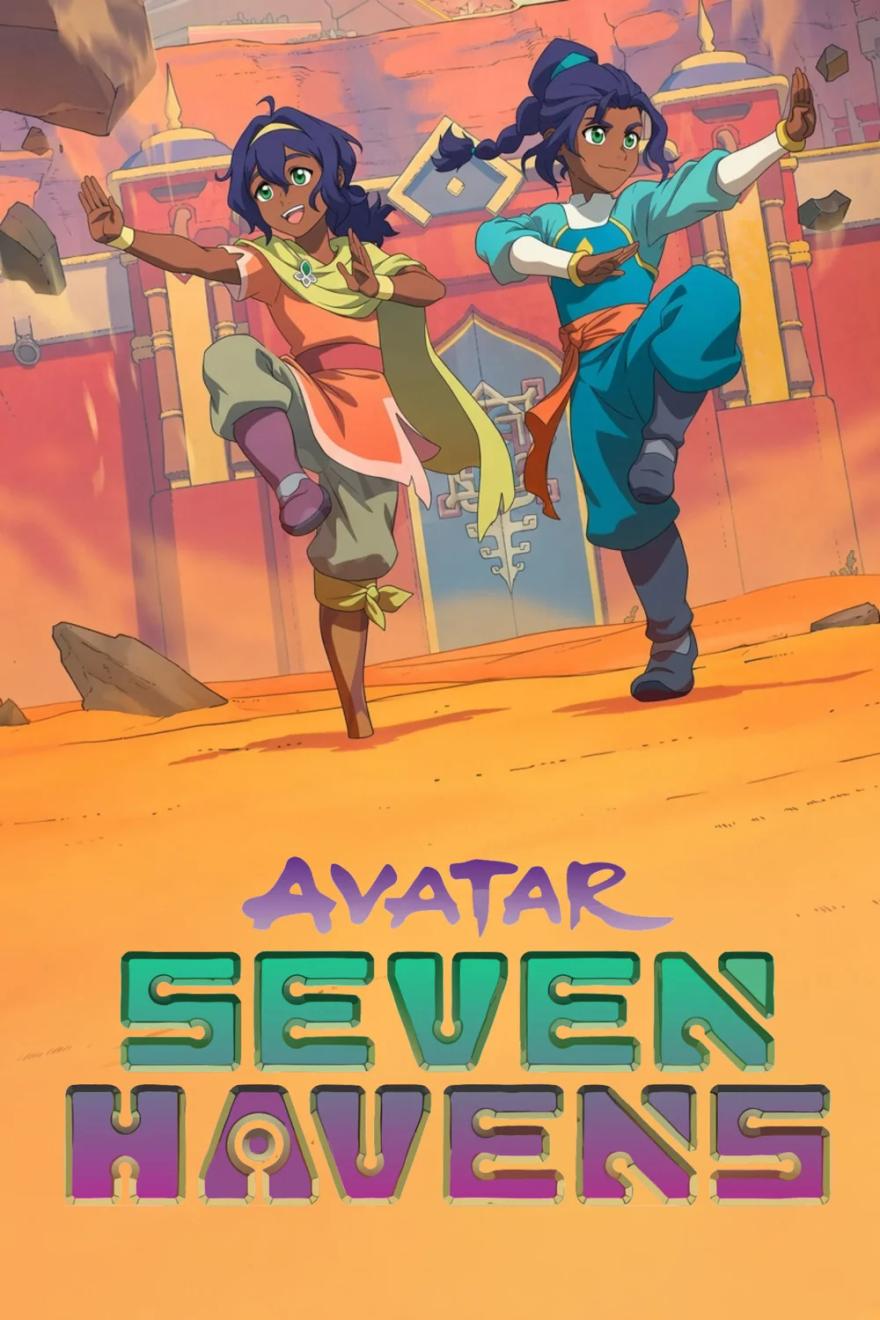
Pavi (Saheli Khan) is a 9-year-old earthbender living rough on the edge of Ellora with her cat-monkey Geet (Dee Bradley Baker), getting around on a wooden leg she made herself. She turns out to be the Avatar, and so does her twin sister Nisha (Aishu Devan). Captain Karthik (Akshay Khanna), an airbender, has been hiding Nisha inside the city's bending brigade, and he is secretly a member of the White Lotus, the old society that protects and trains the Avatar. Neither girl remembers their parents.
The main characters have a mix of Indian and East Asian names, which gives this corner of the Avatar world a different feel.
Who is Avatar: Seven Havens for?
I'm not sure who this show is for. The Last Airbender had plenty you would associate with a children's show, but it had the scope, personality and depth for adults to appreciate it too, and it balanced comedy, action, story and politics. The Legend of Korra felt more adult: Korra was 17, and the politics and spirituality hit so hard that even its teenagers had to think like adults to grasp what was going on.
Seven Havens goes the other way. The twins are 9, but they behave more like 6 or 7, and the setup feels aimed at children of 5 or 6. Aang was young and very naive, but he was an Air Nomad, so that was part of who he was, and he still wasn't as naive as these two.
Seven Havens' plot and world-building are strong enough to carry something older. With the story and the politics front and centre alongside the bending, this show would have worked much better.
The slow first half
The first episode makes almost nothing clear, and only by the end of episode 3 does it feel like something is actually happening. The show has too much to set up at once: a world that hates the Avatar and why, a pair of Avatars, their training, and a spirit threat creeping into the city. It doesn't do any of them perfectly, and for a long stretch it keeps opening new threads without closing any.
You do need to meet a lot of characters before the ending can pay off. But a build-up shouldn't be boring, and too often this one is.
Episodes 7 to 9 are a big improvement, once the politics and the different factions inside Ellora come out.
Bending and action
The action sequences are bad, and there is hardly anything great in them. Animation is sometimes good and sometimes bad.
The earlier shows hooked you on bending in different ways. In The Last Airbender the world itself was new, so even when nobody was bending much, the world-building and the spectacle did the work, and you learned bending alongside Katara. By its second episode, The Legend of Korra had Korra in a pro-bending match, a sport where teams of benders fight in an arena, so you saw straight away what these powers could do.
Seven Havens has nothing like that, and often it isn't clear why something is happening. When the twins are together they can hold back or get rid of the spirit energy, but the show never shows how they do it. Maybe the art of bending was lost in the Cataclysm along with the people who knew it, but if bending is weak for that reason, the show should say so plainly, because right now viewers have to guess.
Ellora and Chancellor Kayoko
By the last four episodes, the reasons Ellora sees the Avatar as a destroyer are clear. Chancellor Kayoko (Jennifer Sun Bell), who heads the city's council, believes that story completely.
You would call her brainwashed, because you are watching from outside. As I read her, she grew up believing, deep down, that the Avatar is a destroyer, which isn't true, and she behaves that way. Watching her, I kept asking what she was doing and why she couldn't see it, but from her side she was doing the right thing, and so were a lot of the people around her.
The weight of that belief, and what it does to someone's mind, is never properly shown.
Seven Havens and The Legend of Korra
In Korra's time there were cars and giant robots, and 225 years on I half expected people to be using AI. Instead there is hardly any usable technology, which shows how huge the Cataclysm must have been, and everyone in Ellora lives like a frog in a well, with no idea what is outside.
Korra's full story is still pending. My guess is that she was trying to save people and either couldn't, or did it at a great cost. The tales get told by the people who survive, as the saying goes, so if the Avatar's supporters died or went underground, the survivors who saw the devastation shaped the story for every generation after.
If the biggest answers turn out to be about what Korra did, though, Seven Havens becomes The Legend of Korra 1.5, a show built to keep Korra fans invested. Honestly, Korra's story deserves a film or a miniseries of its own.
Major Curda as Jae
The best character arc in Seven Havens belongs to Jae (Major Curda). He starts out as a squad leader in Ellora's bending brigade, one of the people who really believe in the city's cause, and his cause shifts when he joins the White Lotus.
Strangely for an Avatar show, this arc doesn't belong to an Avatar, and I think it shows where the season falls short. Jae has spent enough time in the world to understand it, and the twins are too naive to. That gap makes the show a little weird and a little less impactful.
The spirit world and the chakras
Like the earlier shows, Seven Havens leans on spirituality and finding your purpose. The Last Airbender made it clear early on that spirits and meditation mattered, and The Legend of Korra added new kinds of bending, spiritbending among them, and showed how important the spirit realm is.
This time the focus is chakras. I read opening the chakras as a spiritual awakening: when you are born there are too many distractions and your mind runs in every direction, and opening your chakras means learning to focus and reach a greater stage in life, or greater satisfaction. The Last Airbender touched on them with Guru Pathik.
This season is mostly about discovery, and I expect the twins' real character arcs to come in the seasons after it.
Is Avatar: Seven Havens worth watching?
Yes, if you can get through the first half. Seven Havens is a good show, if not the best, and the season ends on a very high note, even if the ending is abrupt. If every episode were at the level of the last four, I would have given it a 4 or even a 4.5, though I don't know how many people will make it that far.
When you stop for a break while climbing stairs, you carry on from the step you stopped on instead of starting from the bottom. I hope Book 2, the next season, does the same, with more action and a lot more bending, because the premise is amazing and this show has huge potential.
Three bulbs out of five: Glowing.
Why the spirit was attacking. The last four episodes finally explain the Anomaly, the spirit energy that has been attacking Ellora all season, and it comes from one of the sisters. When the twins were small, their parents, Pramodh (Sean T. Krishnan) and Saumya (Anjali Bhimani), slipped away one night with Pavi (Saheli Khan) and left Nisha (Aishu Devan) behind. Nisha woke, followed them across the Harshlands and, terrified of being abandoned, pulled in so much spirit energy that it became the Anomaly.
Why Nisha was left behind. Their parents feared her power, but they had sent for help: Karthik (Akshay Khanna) was meant to find her and train her.
How Pavi lost her leg. Pavi was the victim of all of it. The Anomaly's bolts brought down a rockface that seemingly crushed both parents, though no bodies are shown, and Pavi lost the lower half of her left leg.
Nisha is not a villain. As I see it, Nisha isn't bad at heart. She was too young, she had no control over her emotions, she felt abandoned and she lost control. The show lays out the whole backstory and its impact on both girls, and it's really great stuff.
Agam and the Faceless. Agam (Sakina Jaffrey), the kind baker who keeps feeding Pavi, turns out to be the Faceless Queen, leader of the masked bandits who raid Ellora's supplies, and she comes out as a hero of sorts. As I read them, the Faceless follow a different cause: they want to live free of Ellora's rules and restrictions. Agam takes the twins in when they are on the run in the Harshlands, and in the last episodes the Faceless team up with the White Lotus to protect the Avatar.
Jae's double game. Jae (Major Curda) seems to side with Ellora against the White Lotus, and Karthik, by now the brigade's commander, ends up locked away. Jae's switch is a cover, and he later frees Karthik and the White Lotus. He is out to prove himself, and when he believes a cause is right he will go head to head even with his partner, Datu (Topher Ngo). By the end he is on the same side as the Faceless his squad was trying to stop earlier in the season.
Pavi's root chakra. Pavi ends the Anomaly, sending its energy up into the sky. In the Spirit World she sees past Avatars, among them Kyoshi, Aang and Korra (Cia Court), and a silent Korra shows her that her root chakra, the first of seven, has opened. Pavi realises what opened it: she let go of her fear and accepted that she is the Avatar. Her next chakra shows her the Floating Isles, and when she asks whether they are in trouble, Korra says nothing.
The split. Pavi pushes Nisha away, takes their mother's stone and tells her, "I won't be a destroyer like you, I'll be a better Avatar." Nisha stays in Ellora with Karthik, hailed as the city's saviour, with her own root chakra still blocked.
Jae goes with Pavi. Pavi sets off for the Floating Isles with Geet (Dee Bradley Baker), and Jae catches up outside the walls to come with her. From the way he puts it, she feels she is doing him a favour by letting him come, though the two of them have had a good bond from the start. In a way, two good people now protect the Avatars and guide them, Jae with Pavi and Karthik with Nisha, so nobody can take advantage of them.
The abrupt ending. It stops so suddenly that I wondered whether a few more episodes were coming, until Pavi set out for a new Haven and it was clear Book 2 starts there.
What is still open. The season never says why there are two Avatars, or why the Avatar seems to have been gone for so long after Korra. Nor does it settle what Korra did during the Cataclysm, and how Ellora came to blame her: a flashback earlier in the season puts her at the centre of Republic City's destruction without explaining it. I expect more answers once Pavi reaches the other Havens, and maybe some old places too, like the air temples or Republic City itself.
Where the sisters go next. I think every season will end with the twins unlocking a new step in their spiritual growth, and that they will patch things up by the end of the four seasons. It would be more interesting to see them end up on opposite sides, two sides of the same coin.
Read next, with spoilers
Also in Avatar
What Are the Seven Havens? Every City in Avatar: Seven Havens, ExplainedEllora, Akasha, New Ba Sing Se, Feather Mountain, Republic Forest and the Floating Isles: what Book 1 shows of each Haven, and what keeps them apart.- The Seven Chakras in Avatar, Explained: What Pavi's Root Chakra MeansGuru Pathik's seven chakras, what blocks each one, and why Pavi opening her root chakra sets the course for the rest of Avatar: Seven Havens.
- Did Korra Cause the Cataclysm? What Seven Havens and the Comics Say About KorraSeven Havens blames Avatar Korra for the Cataclysm. What the show, the end of The Legend of Korra and the comics really show, and what is missing.
Bright Bulbs
- The sisterhood between Pavi (Saheli Khan) and Nisha (Aishu Devan) is shown really well.
- The characters, the twins included, are good human beings, down-to-earth and not as complicated as Korra's cast, so it's great to see good things happen to them.
Dull Bulbs
- Karthik (Akshay Khanna) is good in the early episodes, but towards the end of the season he is hardly doing anything.
- The character designs are okay but don't match the first two shows, and some of the hairstyles look like they belong in the later Pokémon seasons.
Shattered Bulbs
- In the early episodes, most of the jokes fall flat, and there are scenes the show should simply have cut out.
- Every episode ends on a cliffhanger, but those cliffhangers aren't that great, so they don't stop the early episodes from getting boring.
Cast
- Saheli Khan as Pavi
- Aishu Devan as Nisha
- Major Curda as Jae
- Akshay Khanna as Karthik
- Sakina Jaffrey as Agam
- Jennifer Sun Bell as Kayoko
- Darren Barnet as Daemin
- Topher Ngo as Datu
- Dianne Doan as Zi
- Dee Bradley Baker as Geet / Ruhi
- Clyde Kusatsu as Bountan
- Zehra Fazal as Shilpa
- Andrew Kishino as Hamka
- Xanthe Huynh as Lan
- Kimberly Woods as Uki
- Anjali Bhimani as Saumya
- Sean T. Krishnan as Pramodh
- Cia Court as Korra