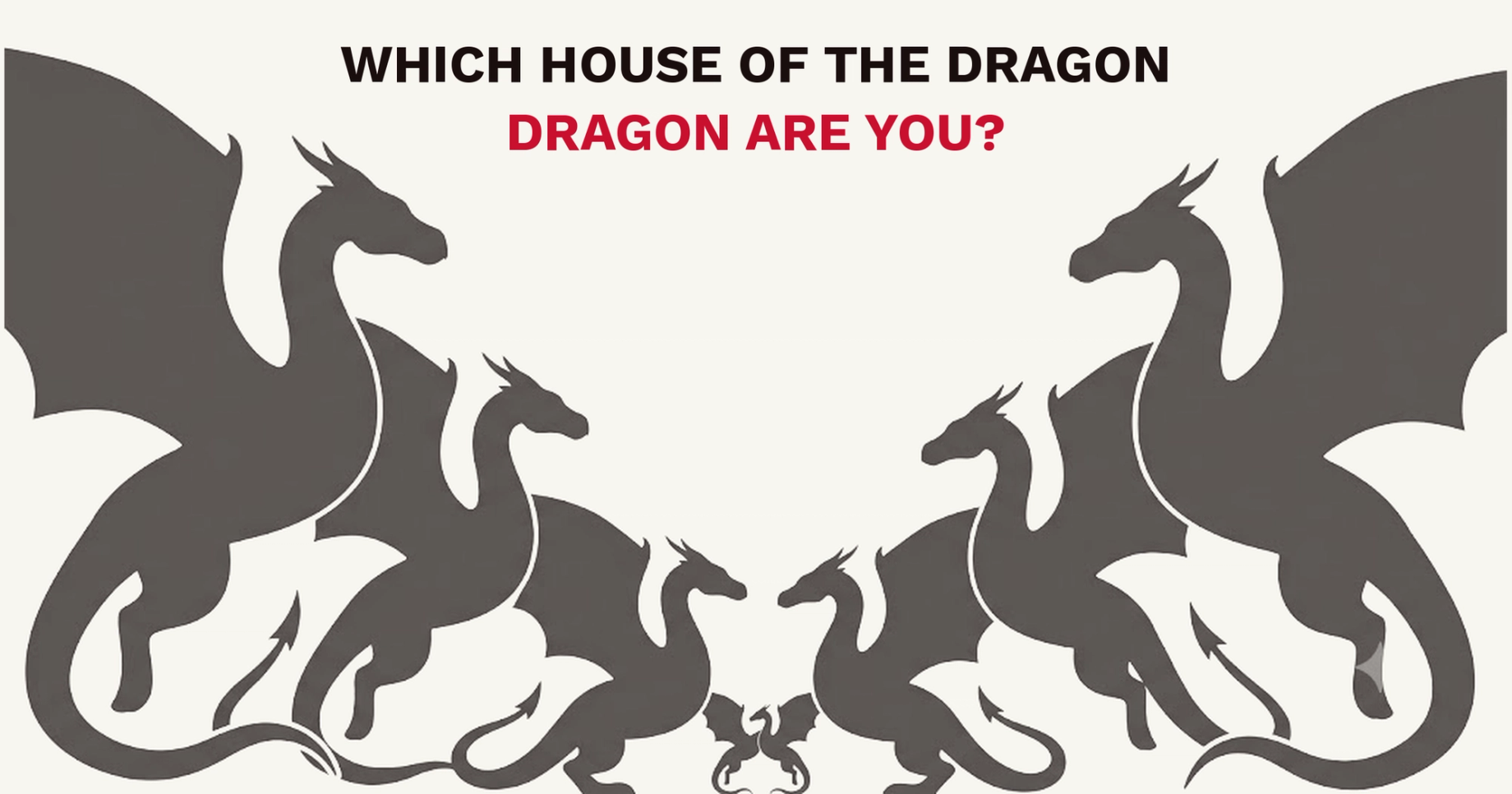
QuizHouse of the Dragon
Which House of the Dragon dragon are you?
Fourteen dragons, each one somebody you know: the giant who is bored of you, the one whose whole personality is another dragon. One of them is you.
Answer as yourself, and you will get the dragon most like you.
The quiz did not load. Reload the page to try again.
YOUR ANSWERS STAY ON YOUR DEVICE
Meet all 14 dragons
SEE ALL ↓ Vhagar
 Caraxes
 Sheepstealer
 Meleys
 Sunfyre
 Syrax
Syrax Seasmoke
 Vermithor
 Silverwing
 Moondancer
 Vermax
 Arrax
Arrax Dreamfyre
 Tessarion
01 / 08
You finish your work by noon, and nobody needs anything else from you. What do you do?
02 / 08
A close friend leaves your life. Does someone else take their place?
03 / 08
You are told to wait outside a closed door. Nobody says how long. What do you do?
04 / 08
You are halfway along a familiar road when something feels wrong. Do you keep going?
How much that stops you
CHOOSE A POINT ON THE LINE
Your dragon is starting to take shape.
05 / 08
Someone takes something of yours and acts like it is theirs. How far do you take it?
CHOOSE A POINT ON THE LINE
06 / 08
You have a free Saturday and nobody expects you anywhere. What do you do?
07 / 08
You are offered a good job, working under someone else. What do you do?
08 / 08
Your work is finished and your calendar is clear. How long before you get restless?
CHOOSE A POINT ON THE LINE
Meet all 14 dragons
 VhagarYou have seen it all before. It was not impressive then either.
 CaraxesEveryone finds you strange until something goes wrong. Then they call you.
 SheepstealerYou are impossible to keep, and that is not entirely a compliment.
 MeleysYou know exactly what you are worth, to the decimal point.
 SunfyreEverybody meets the polished version. Almost nobody meets you.
 SyraxYou are all softness, right up until someone threatens your person.
 SeasmokeYou do not wait to be chosen. Results have been mixed.
 VermithorYou would follow one person anywhere, and you could not say why.
 SilverwingThings other people fight for tend to land in your lap.
 MoondancerYou volunteer first, especially for jobs far too big for you.
 VermaxYou are great at a job you never applied for.
 ArraxYou never feel ready, and nobody would ever guess.
 DreamfyreNobody has any idea what you are capable of. Neither do you.
 TessarionYou do the jobs nobody wants their name on, and never complain.
PLAY NEXT
READ NEXT
The long read
5 min read
The Dance of the Dragons is usually described as a succession crisis. Two claimants, one throne, a great many dead. That is accurate and it is also the least interesting way to read it, because the humans in this story are mostly interchangeable and the dragons are not.
Watch it again and count what differs. The riders want the same thing in roughly the same way. The dragons want fourteen different things, and several of them want nothing at all, and one of them is only interested in being near another dragon. That is where the character work is.
Size is not the interesting variable
The obvious way to rank dragons is by how much of the sky they take up, and the show encourages it — the largest is treated as an argument that ends conversations. But size explains very little about how any of them behave.
The oldest and largest spent decades doing nothing, unridden, in a yard, without a single recorded incident. Whatever makes her dangerous is not switched on by being large. It is switched on by having someone on her back, which is a completely different fact and a much more unsettling one.
Meanwhile the smallest thing here, no bigger than a warhorse once you take the wings out of the measurement, went at a king's dragon from underneath, at dawn, and did enough damage that it never flew properly again. She lost. She also won, on a delay, which is a thing only she manages.
The one that predicts behaviour is not size. It is temperament, and the sources are surprisingly specific about it once you go looking.
What the record says
Some of these dragons have documented personalities in a way that is unusual for animals in fiction.
One is described as hating the cold. Not as a metaphor — the chronicler records that snow and ice made him irritable, and that this shortened a diplomatic visit where his rider was being made extremely welcome. An alliance ran on a schedule set by a dragon's discomfort.
One was named the fiercest of the young dragons before he had done anything at all, purely on how he carried himself. Seventy years did not argue with the assessment.
One is described as friendly to strangers, which is not said about anything else in the story, and then refused to cross something three separate times, hissing at the air, for reasons nobody has ever established.
One spent his entire life beside another dragon, decades after any human reason for the arrangement had ended, and nobody thought to explain it because there is no explanation. He simply wanted to be there.
These are not the same creature painted different colours. They are fourteen animals with fourteen dispositions, and the war happens to them in fourteen different ways.
The bond is the real subject
The other thing that separates them is who they belong to, and how completely.
Some of these bonds were arranged before either party could object — an egg placed in a cradle, a dragon and a child growing up together into a relationship neither of them chose. Those dragons are loyal in a way that has never been tested, and there is something faintly hollow about it. Total commitment that was never a decision is not the same as commitment.
Others chose. One went out and found his own rider, which nothing else in the story bothers to do — flew off the island, tracked down a specific person, and cornered him until he understood what was on offer. Another refused every claimant for the better part of a century and then permitted exactly one, and the terms were entirely his.
And one accepted four riders across nearly two centuries, served each of them faithfully to the end, and belonged to none of them.
That distinction — staying versus belonging — turns out to be the sharpest line through the whole roster. You can have one without the other in either direction, and the dragons that have both are the ones the story is about.
Why a quiz works on this
Personality quizzes usually fail on the source material. They pick a franchise with four recognisable characters, invent traits the text does not support, and hand out results that are all flattering in slightly different registers.
This roster does not have that problem. The temperaments are documented, they differ, and several of them are not remotely flattering. There is a dragon here whose defining characteristic is that nobody finds him threatening. There is one who has been comfortable for so long she has stopped practising anything difficult. There is one who cannot stop, at all, ever, and it is not presented as a strength.
If you land on one of those, the result says so. That is the point. A quiz where every outcome is a compliment is measuring nothing, and the reader knows it before they have finished reading.
The ten things being measured
The quiz reads ten traits and matches your profile against all fourteen dragons at once. Some are obvious — how readily you go at a problem, how long you can wait, how much you need other people around.
Others are less obvious and do more work.
- Drive is not ambition. It measures how much you need to be doing something, and a person with no ambition whatsoever can score at the top of it.
- Volatility is not temper. It measures whether you are the same person under pressure as at rest — a consistently furious person scores low, because at least everyone knows what they are getting.
- Attachment is not loyalty. Loyalty is whether you stay. Attachment is whether the specific person matters, or whether it is the role you are attached to and the occupant is replaceable.
That last pair is where most results are decided, and it is the distinction the source material draws most clearly. Fourteen dragons, and the difference between the ones who stayed and the ones who belonged is the whole war.
Eight questions will tell you which one you are.
About the art
We came to this show on the coattails of Game of Thrones, which ended badly enough that House of the Dragon had something to redeem. Then the Dance arrived and the dragons started falling left, right and centre.
So for the length of this quiz, we would like the Dance of the Dragons to be about the dance.
That is why they are drawn small. Not hatchlings, but cuter versions of themselves, each one doing the thing that gives it away. Some of it is ridiculously exaggerated, and if you have watched the show or read the book you will know which parts. Affection, not mockery.
#NoCrueltyToDragons
This is a quiz about fictional dragons. It is not a personality test, a psychological assessment, or advice of any kind.