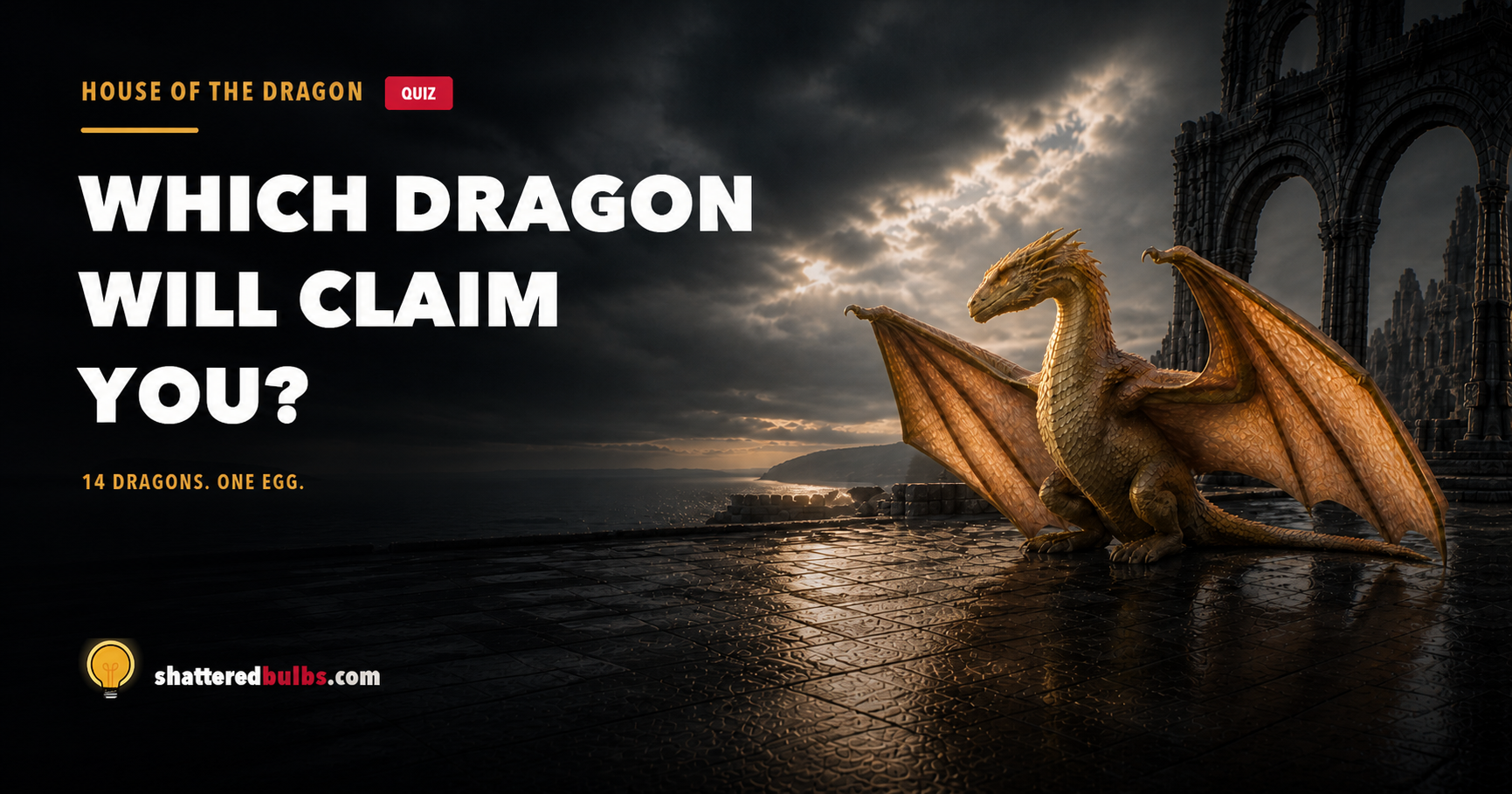
QuizHouse of the Dragon
Which dragon would you end up with?
Fourteen different riders, each with a dragon, and one egg still waiting. One of those riders just wanted a drink. Which House of the Dragon pairing looks most like you?
Answer as yourself, imagining life alongside a dragon of your own.
Spoilers through the House of the Dragon Season 3 finale. Nothing here uses later episodes or book-only outcomes.
The quiz did not load. Reload the page to try again.
YOUR ANSWERS STAY ON YOUR DEVICE
Meet all 14 dragons, and the egg
SEE ALL ↓ Syrax
Syrax Sunfyre
 Dreamfyre
 Moondancer
 Vermax
 Tessarion
 Arrax
Arrax Vhagar
 Vermithor
 Sheepstealer
 Caraxes
 Meleys
 Seasmoke
 Silverwing
 The Egg
01 / 08
The Uninvited Guest
A dragon lands in the barley field outside your village and has burned nothing yet. What do you do?
02 / 08
No Land in Sight
You are hours out over grey sea with no land in sight. How do you want your dragon to fly?
03 / 08
The Worst Moment
Everything goes wrong at once: smoke, shouting, no clear way out. What do you need most from your dragon?
04 / 08
A Crowd of Strangers
You fly your dragon into a strange city, and crowds gather to stare. What impression do you want to leave?
Still airborne. Mind the tail.
05 / 08
No Words Needed
Your dragon cannot talk. In your first year together, which small sign from it would mean the most to you?
06 / 08
A Crown in Reach
A crown is within reach, but your dragon has its own will. What partnership do you want?
07 / 08
A Week Without War
There is no war this week, only rain and your dragon. How do you spend the days?
08 / 08
Coming Home
After weeks away, the towers of home come into view. How do you want your dragon to land?
Meet all 14 dragons, and the egg
 SyraxDuty feels like home to you. Drama waits its turn.
 SunfyreYour devotion survives ruin. It just comes back looking worse.
 DreamfyreYou notice everything and say almost none of it.
 MoondancerYou move before the meeting starts. Someone has to.
 VermaxYou took on duty early and carried it too far.
 TessarionThey kept you on the sidelines until they needed you.
 ArraxYou would rather leave than fight. The sky may disagree.
 VhagarYou were denied once. You have taken up space ever since.
 VermithorLoss behind you, a dragon ahead, and you keep walking.
 SheepstealerThe usual doors stayed shut, so you stopped knocking on them.
 CaraxesYou act first and let the room catch up.
 MeleysYou saw the risk clearly and went anyway.
 SeasmokeYou never asked for the weight. You carry it steadily.
 SilverwingYou wanted a drink, got a dragon, and negotiated upward.
 The EggYou hold the beginning of a dragon. It is still warm.
PLAY NEXT
READ NEXT
The long read
4 min read
The show rarely explains itself
House of the Dragon shows a dragon accepting a rider several times and explains the reason almost never. That silence is the most consistent thing about claiming in this series, and it is why this quiz is built on resemblance rather than selection.
Look at what happens. Aemond walks up to an unclaimed Vhagar at Driftmark and takes her, and the scene is nerve and appetite meeting an animal who does not object. Seasmoke reverses it completely: the dragon goes looking for Addam, corners him after he runs, and the show never settles what the dragon saw in him. At the Red Sowing, Hugh approaches Vermithor after the dragon has already killed other candidates, speaks to him, and rides away on his back. In the same sequence, Ulf stumbles into Silverwing's lair while trying to get away from the whole situation, and leaves on her back.
Four claims: nerve, being chosen, grief walking toward the catastrophic animal, and an accident. No shared mechanism. No rule the show is quietly teaching you.
The counter-example matters as much as the claims do. Ser Steffon Darklyn approaches a dragon with a plan, a pedigree and the confidence of a man who has thought it through, and he is burned to death. Whatever is happening in these scenes, it is not a technique — and anyone offering you one is offering something the show has already refuted.
What the quiz is matching
Not worth. Not courage. Not bloodline, and not whether you would survive a bad idea in a cave.
It matches three things: how you approach power, what kind of bond you can live with, and the kind of trouble you are prepared to share. Those answers are compared against the person each dragon ended up with — Rhaenys assessing the risk correctly and going anyway, Rhaena refusing to let rejection become a permanent description, Ulf converting an accident into a better offer.
The result describes a resemblance to that partnership. It does not describe your future, your character, or your standing against anyone else who took the quiz. Fourteen dragons and one egg, and none of the fifteen is a ranking.
Some of these dragons are dead
At this quiz's boundary, several are. Vermax dies with Jacaerys at the Gullet. Arrax dies in the pursuit away from Storm's End. Meleys dies at Rook's Rest. Helaena's death in the finale leaves Dreamfyre riderless.
The quiz does not pretend otherwise, and the result copy says so where it applies. A dead dragon is still a legible partnership: Rhaenys and Meleys were an experienced war pairing whether or not the pairing survived the episode. Matching them is a statement about how you decide, not a claim that the dragon is available.
Some of them are barely shown
Tessarion has care and recognition on screen — Daeron tending her in the Hightower camp — and very little else. No flight profile, no combat preference, no sustained record under pressure. Dreamfyre gets one flight with Helaena in Season 3, which establishes a partnership and almost nothing about temperament.
Where the evidence is thin, the result says it is thin. It would be easy to fill those gaps with invented traits, and the results would read more confidently for it. They would also be lying to you about a show you have already watched.
The egg
Not every set of answers resolves to a dragon. Some land on an egg instead.
That is not a failure state and not a consolation prize. It is the honest outcome for answers describing someone who noticed the thing that needed keeping and made room for time to do its work. Nothing has hatched. Nothing has been promised. That is the result, and it is a real one.
What this quiz will not do
It will not tell you a dragon chose you because you deserved it. It will not read your answers as a diagnosis. It will not claim to know why Seasmoke went looking for Addam, because the show does not say, and inventing a reason would make the result worse rather than deeper.
It also will not reach past its boundary. Everything here comes from what has aired through the Season 3 finale. Book material is a different continuity and is not blended in: where the books extend or contradict what is on screen, that material stays out rather than being quietly folded into a result. If a later episode changes what a claim meant, the result copy is what changes — not your answers.
Before you start
Answer as yourself rather than as the character you would like to resemble. The scoring cannot tell the difference. You can, and the result is only interesting if the answers were.
The dragon you get is not a verdict. It is an argument about the kind of person this show keeps pairing with that particular animal — and if you disagree with it, the disagreement is the good part.
About the art
Fifteen plates, one for every way this quiz can end. Fourteen dragons are drawn at full size in grey light, among old stone, ruins, shores and a camp. The fifteenth is an egg in a stone cradle, still waiting.
Our other dragon quiz draws them small and fond. This one draws them the size they are on screen, because being claimed by one is not a small thing.
This is a quiz about fictional dragons. It is not a personality test, a psychological assessment, or advice of any kind.