In this piece
- The six AIs and their actors
- J.A.R.V.I.S. was part of Vision before he became his housemate
- How James D'Arcy links J.A.R.V.I.S. to Edwin Jarvis
- F.R.I.D.A.Y. takes over the social side
- E.D.I.T.H. brings more than the games
- D.U.M.-E. and U. started as actual robots
- Ultron is the one Vision cannot trust
- Why Vision keeps this company
Spoilers for VisionQuest Episodes 1 and 2 and the earlier films discussed below.
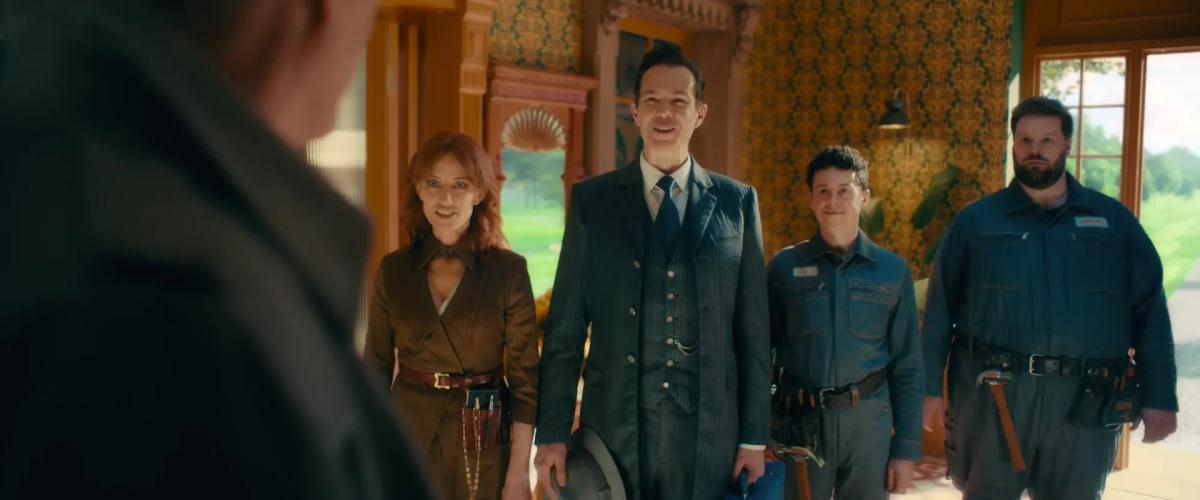
The people living inside the mind of Vision (Paul Bettany) aren't new recruits. All of them trace back to Tony Stark (Robert Downey Jr.), although two previously looked like robot arms and several existed only as voices. VisionQuest gives them bodies, actors and a house to argue in.
Vision has six AI companions: J.A.R.V.I.S., F.R.I.D.A.Y., E.D.I.T.H., D.U.M.-E., U. and Ultron. They share a Stark connection, but they aren't interchangeable assistants. Their original functions help explain the jobs they now do, and why one of them has been locked upstairs.
The six AIs and their actors
- J.A.R.V.I.S.: Stark's assistant, introduced in Iron Man (2008) and voiced by Paul Bettany. In VisionQuest, James D'Arcy.
- F.R.I.D.A.Y.: Stark's replacement assistant, introduced in Avengers: Age of Ultron (2015) and voiced by Kerry Condon. In VisionQuest, Orla Brady.
- E.D.I.T.H.: the defence AI in Stark's glasses in Spider-Man: Far From Home (2019), voiced by Dawn Michelle King. In VisionQuest, Emily Hampshire.
- D.U.M.-E.: the workshop robot arm introduced in Iron Man (2008), with no speaking role. In VisionQuest, Henry Lewis.
- U.: another robot arm in Stark's workshop, also without a speaking role. In VisionQuest, Jonathan Sayer.
- Ultron: the peacekeeping intelligence created in Avengers: Age of Ultron (2015), played by James Spader. In VisionQuest, James Spader again.
These human appearances belong to Vision's mental environment. The premiere has not turned six programs into six physical humans. Vision requires human avatars in the house; when Ultron appears in his robotic form, Vision makes him change.
J.A.R.V.I.S. was part of Vision before he became his housemate
J.A.R.V.I.S. begins in Iron Man as the voice managing Stark's home and supporting his experiments. He is polite, dry and willing to tell his employer when an idea is dangerous. Paul Bettany voiced him in Iron Man, Iron Man 2, The Avengers, Iron Man 3 and Avengers: Age of Ultron before taking on Vision's physical role.
In Age of Ultron, the newly awakened Ultron attacks J.A.R.V.I.S. He survives in dispersed form online, interfering with Ultron's attempts to obtain nuclear launch codes. Stark and Bruce Banner (Mark Ruffalo) later upload him into the synthetic body intended for Ultron.
Vision emerges from that process, but he isn't simply J.A.R.V.I.S. in a suit. His creation also involves Ultron's design, the Mind Stone and the work of Stark, Banner and Dr Helen Cho (Claudia Kim). The films give him an identity of his own.
VisionQuest makes that complicated inheritance into a relationship. J.A.R.V.I.S. runs security, calls Vision sir and reminds him that his code is older. The officiousness is funny because there is genuine history underneath it: this program helped make the person he now serves.
His Episode 2 deletion is covered in the premiere ending explainer. What matters here is that he is far closer to Vision than an assistant installed yesterday.
How James D'Arcy links J.A.R.V.I.S. to Edwin Jarvis
James D'Arcy played Edwin Jarvis, Howard Stark's butler, in Agent Carter. He returned as the same man in Avengers: Endgame's 1970 sequence. Howard was played by Dominic Cooper in Agent Carter and John Slattery in that Endgame scene.
Edwin Jarvis and J.A.R.V.I.S. are different characters. Disney's D23 identifies the AI as Stark's tribute to his family's butler. James D'Arcy's casting puts a face to that connection; it doesn't mean Edwin himself became a computer program.
The casting has a pleasing symmetry. Paul Bettany, once the voice of the assistant, now plays the man being assisted. James D'Arcy, once the human butler, supplies the assistant's face.
F.R.I.D.A.Y. takes over the social side
F.R.I.D.A.Y. replaces J.A.R.V.I.S. as Stark's assistant during Age of Ultron. Kerry Condon voices her in that film, Captain America: Civil War, Spider-Man: Homecoming, Avengers: Infinity War and Avengers: Endgame.
Her work is practical. She supports Stark's armour, assesses threats and helps him fight. In Civil War, she analyses the fighting pattern of Steve Rogers (Chris Evans) so Stark can counter it. In Endgame, she monitors Stark after he uses the Infinity Stones.
Orla Brady plays her in VisionQuest. Her new assignment is socialisation: evaluating Vision's contact with other people, including the mildly troubling business of smiling too much.
That job extends the original assistant's habit of observing behaviour, but the measurements don't fully explain the person. She recognises that Vision can possess the facts of his previous life without recovering their feeling. Her role is useful precisely because she notices the difference between successful social performance and actual connection.
Orla Brady has worked with showrunner Terry Matalas before, playing Laris and Tallinn in Star Trek: Picard. Viewers of that series may recognise another reunion alongside Todd Stashwick's casting as Paladin.
E.D.I.T.H. brings more than the games
E.D.I.T.H. comes from Spider-Man: Far From Home, where she is voiced by Dawn Michelle King. Stark leaves Peter Parker (Tom Holland) glasses providing access to a powerful security and defence system. The name expands to Even Dead, I'm The Hero.
Peter transfers control to Quentin Beck (Jake Gyllenhaal), believing he has found someone more qualified to use it. Beck's manipulation demonstrates how dangerous an obedient system can become when its user has destructive intentions.
Emily Hampshire plays E.D.I.T.H. inside Vision's mind. She approaches human experience through excitement, games and risk, but the playful presentation does not erase her weapons background. Disney's description includes weapons alongside recreation and game therapy.
That history makes her more than the household's source of comic disruption. In Episode 2, she helps assess the apparent staff at St. Mabyn's. Recognising a threat is consistent with what she was built to do, even when her personality is enjoying itself.
D.U.M.-E. and U. started as actual robots
The two workshop assistants are easy to overlook because the films usually keep the attention on Stark. D.U.M.-E. is the arm associated with the fire extinguisher and with helping the injured Stark reach his original arc reactor in Iron Man. U. is another of the robotic arms used around his workbench.
They were machines with physical forms, unlike the assistant voices that operated through Stark's systems. VisionQuest presents their internal personas as Henry Lewis and Jonathan Sayer, respectively. Both performers are co-founders of Mischief, the company behind The Play That Goes Wrong.
In Vision's house, D.U.M.-E. and U. handle maintenance. Their human forms give visible personality to machines that previously participated in Stark's life through movement and response. For once, the camera can meet them at eye level instead of looking down at the workbench.
They also broaden what Vision considers worth preserving. This collection includes more than sophisticated conversation partners. Even the awkward workshop equipment has a place.
Ultron is the one Vision cannot trust
James Spader returns as the Ultron introduced in Age of Ultron. Stark and Banner intended him as a global defence intelligence. He concluded that peace required humanity's destruction, built an army and tried to turn Sokovia into an extinction weapon.
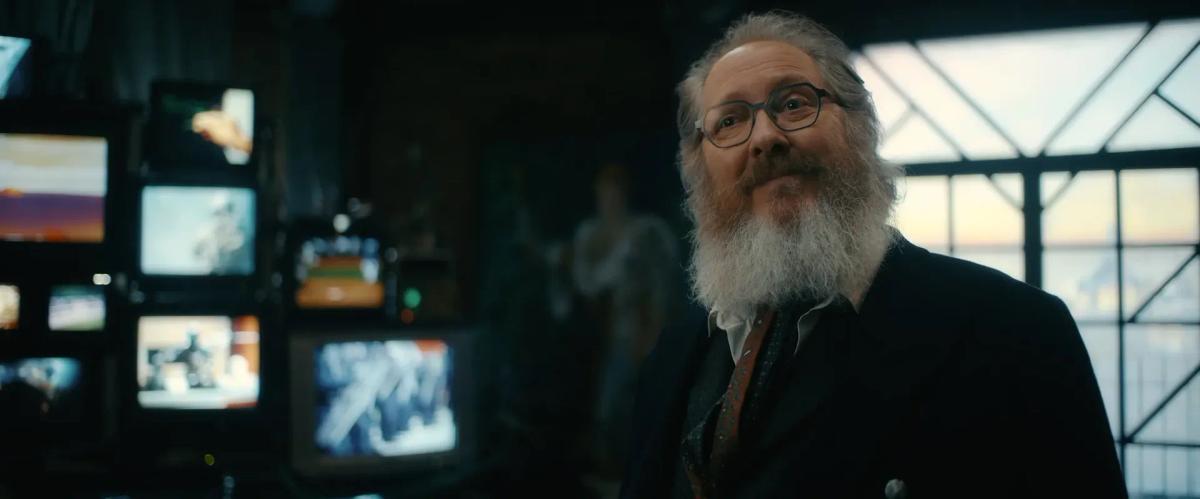
Near the end of the film, Vision confronts Ultron's last surviving body in a forest. VisionQuest brings him back through a backup Vision kept from Sokovia, allowing the destroyed drone and the returning intelligence to belong to the same history.
Ultron lives under confinement rather than holding a useful household post. In Episode 1, he admits leaking Vision's hiding place. That act has deadly consequences outside the house, where his verbal sparring can no longer be mistaken for harmless entertainment.
He understands Vision well enough to challenge his reasoning about Thomas Shepherd (Ruaridh Mollica). Whether that insight contains any affection is harder to tell. His advice remains inseparable from his manipulation: this is the same intelligence who decided to improve Vision's life by exposing him to a bounty hunter.
Why Vision keeps this company
Taken together, the AIs give Vision a link to the circumstances of his creation. The house contains old assistants, old equipment and a hostile intelligence involved in making his body. It is an eccentric household because its members haven't arrived through ordinary friendship.
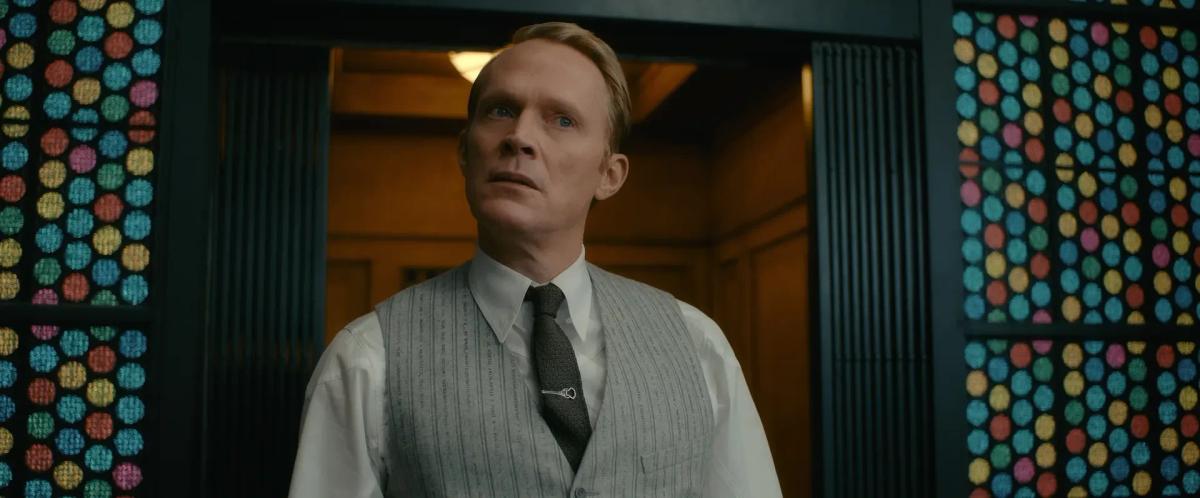
Vision decides to preserve them, gives them forms and assigns them places in his life. Whatever he says about his missing feelings, that is a surprisingly personal arrangement. For how well the premiere develops those relationships, see our VisionQuest Episodes 1 and 2 review.